The standing reach around handjob is frequently idealized as a dominant, spontaneous maneuver. In practice, it collapses into forearm cramps, lower back strain, and broken rhythm within minutes. The failure is not technique — it is biomechanical misalignment.
When humans attempt sustained, high-friction manual movement in an upright stance without adjusting their shared center of gravity, the body recruits the wrong muscles for the job. The anterior deltoid and coracobrachialis — designed for brief evolutionary tasks, not sustained isometric loading — reach metabolic failure fast. Add a height mismatch, and the spine compensates with dangerous flexion that makes optimal angles impossible.
This guide eliminates every one of those failure points using ergonomic kinesiology, tactical grip mechanics, and environmental adaptation. When executed correctly, the standing handjob from behind becomes a relentless, high-stimulation interaction that horizontal positions cannot replicate.
→ New to reach arounds? Start with the Ultimate Guide to the Reach Around Handjob. → First time? Read the Reach Around for Beginners first.
Why Handjob Standing Up Changes the Mechanics
Standing removes the structural scaffolding of a bed or chair, forcing both partners into continuous battle against gravity. This fundamentally alters the kinetic chain — shifting load from large, resilient muscle groups onto smaller, easily-fatigued stabilizers.
How Gravity Shifts Arm Fatigue
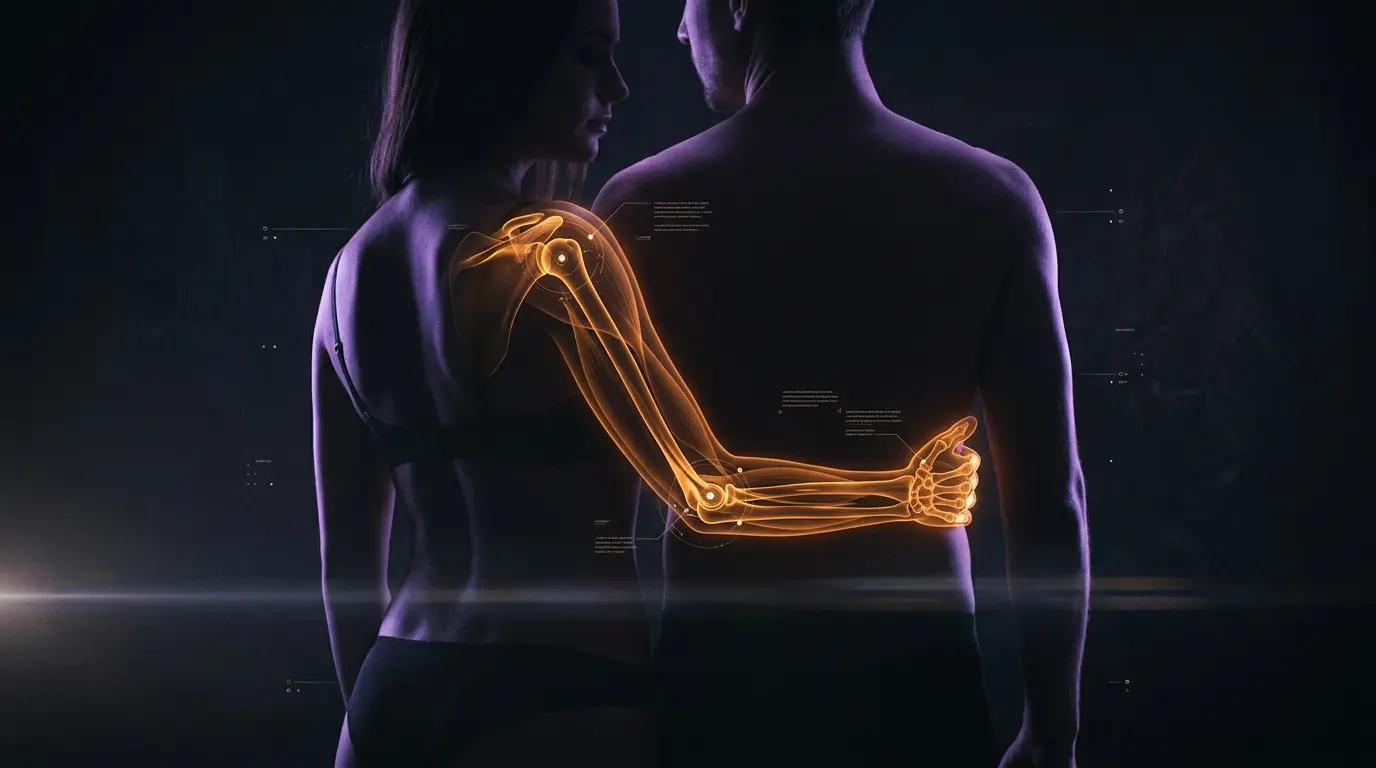
The human arm is optimized to bring objects inward toward the body’s midline. The “Home Zone” — the ergonomically neutral position — requires the elbow to remain close to the torso at approximately the 5 o’clock resting position. In this posture, the skeletal structure bears the load and surrounding muscles stay dormant.
A standing reach around forces the elbow outward to “3 o’clock” or “4 o’clock” — placing intense static load on the coracobrachialis, a small muscle not designed for sustained horizontal loading. Biomechanical analysis indicates this muscle reaches full metabolic fatigue within approximately ten minutes at full extension.
The fix: drop the elbow back to 5 o’clock, tuck it against the ribcage, and drive movement through core rotation and hip shifting — not isolated shoulder flexion.
The Angle Advantage (Upward Pressure Path)
Despite the ergonomic challenge, standing offers one distinct mechanical advantage: gravity-assisted upward pressure. With both partners upright, the giver’s hand approaches from below in an ascending stroke that directly targets the frenulum — the most nerve-dense tissue on the ventral shaft surface.
In horizontal positions, targeting this area requires awkward wrist contortions. Standing eliminates this entirely. Furthermore, by widening the stance and shifting weight rhythmically between feet, the giver generates stroke power from the lower body — mimicking athletic force transfer and dramatically delaying muscular fatigue.
Standing vs Lying Down — Quick Comparison
| Metric | Standing Reach Around | Spooning (Lying) | Seated (Lap) |
|---|---|---|---|
| Access Angle | ✅ High — upward trajectory, excellent frenulum access | Moderate — lateral, restricted mobility | High — direct anterior access |
| Giver Fatigue | ❌ High — anterior deltoid strain | ✅ Low — mattress supports body weight | ✅ Low — thighs support forearm |
| Receiver Arousal State | ✅ High — sympathetic activation, dominant posture | Moderate — parasympathetic relaxation | Moderate |
| Core Stability Required | Maximum — both partners actively balancing | Minimum — fully supported | Moderate |
→ See how standing ranks against 12 positions in Best Reach Around Handjob Positions Ranked by Difficulty.
The Height Difference Problem (4 Fixes)
Height disparity is the most common structural failure point. Two inches of height difference can shatter pelvic alignment entirely. Here are the four biomechanical fixes ranked by difficulty.
Fix #1 — Stance Widening (Lower Your Center of Mass)
For minor to moderate height disparities (2–6 inches) where the giver is taller, deliberately increasing lateral foot distance past shoulder-width lowers the center of mass along the vertical axis — dropping pelvic alignment down to the receiver’s gluteal region without lumbar compensation.
Bonus: the wider base allows rhythmic side-to-side weight transfer, generating hip-driven stroke power that reduces forearm fatigue significantly.
Fix #2 — Surface Elevation (Step, Stool, or Stair)
When the giver is significantly shorter (8+ inch gap), bodily adjustments are insufficient. A medical step stool, low ottoman, or staircase physically elevates the giver’s pelvic region to align with the receiver.
Elevation restores the ergonomic Home Zone: the elbow drops to 5 o’clock, the shoulder stays relaxed, and the upward reverse-grip stroke becomes effortless. A staircase is ideal for extreme gaps — each step provides precise micro-adjustment.
Fix #3 — Lean-Forward Setup (Receiver Braces on Surface)
When the giver is significantly taller, hinging the receiver forward over a stable surface (wall, bed edge, countertop, heavy dresser) achieves two things simultaneously: it lowers the receiver’s vertical profile AND extends the gluteal region outward, closing the distance the arm must reach.
The braced surface absorbs all kinetic energy, creating a rigid closed-loop system that allows the giver to apply aggressive pressure without destabilizing the receiver.
Fix #4 — One-Knee Drop (Kneeling Hybrid)
When furniture is unavailable and height gap is extreme, the taller giver drops one knee to the floor in a lunge position while keeping the other foot planted. This asymmetric half-kneeling stance drops pelvic height dramatically while retaining the lateral mobility and hip-drive of a standing posture.
The planted foot acts as a dynamic piston; the dropped knee provides a secondary anchor point. Requires moderate quadriceps endurance from the giver.
| Height Situation | Fix | Equipment | Access Score |
|---|---|---|---|
| Giver 2–6 inches taller | Stance Widening | None | 9/10 |
| Giver 8+ inches shorter | Surface Elevation | Step stool / Stairs | 8/10 |
| Giver 8+ inches taller | Lean-Forward Setup | Bed edge / Counter | 10/10 |
| Extreme gap (giver taller) | One-Knee Drop | Rug / Yoga mat | 7/10 |
→ See all standing angle variations in Reach Around From Behind: Positions and Angles.
Step-by-Step: How to Do a Standing Handjob From Behind
Step 1 — Lock the Anchor Arm Around the Waist
The non-dominant arm is the structural foundation — not the dominant hand. Wrap the anchor arm firmly around the receiver’s waist, pulling them tight against your body. This binds both centers of mass together into a single, stable unit and unlocks hip-driven movement from the core rather than isolated shoulder flexion.
Step 2 — Establish Hip-to-Hip Contact
Close all spatial gaps by pressing the anterior pelvic region against the receiver’s posterior. This contact:
- Creates a direct tactile feedback channel — you feel every shift in tension and breathing
- Allows the gluteus maximus and quadriceps to generate the stroking rhythm rather than the forearm
Step 3 — Route the Reaching Arm (Over-Hip vs Under-Arm)
Over-hip routing: The arm drapes over the iliac crest downward. Best when the giver is taller. Creates a steep upward stroke angle that targets the ventral structures directly.
Under-arm routing: The arm passes horizontally around the ribcage. Used when the giver is shorter or elevated on a step. More restrictive to the coracobrachialis but effective for high-pressure final-stage grips.
Step 4 — Set Initial Grip and Pressure Baseline
Gravity drives increased arterial blood volume downward in standing posture, causing more intense vasocongestion than horizontal positions. A grip calibrated for a semi-erect horizontal state will become painfully tight standing up.
Use a fluid, adaptive grip — let the wrist act as a universal joint, absorbing involuntary pelvic tilts and weight shifts without transferring torque to the shaft.
Step 5 — Sync Hand Rhythm with Breathing
Press your chest firmly against the receiver’s back. Humans naturally mirror the respiratory rate of those in close physical contact. By slowing your own breath and syncing the downward stroke with exhalation and the upward stroke with inhalation, you regulate the receiver’s sympathetic arousal — extending endurance and building toward a more controlled climax.
→ Deep dive into technique execution: How to Give a Perfect Reach Around.
🏆 Essential for Standing: Swiss Navy Silicone Lube
Long-lasting, non-drying formula — rated #1 for sustained manual stimulation. 4.8/5 stars.
Shop on EdenFantasys ➜Best Grips for Standing Handjob Position
The grip determines friction surface, neurological stimulation intensity, and muscular longevity. A wrong grip in vertical stance forces the wrist into ulnar/radial deviation — causing rapid cramping and rhythm collapse.
The Reverse Grip (Primary for Standing)
The foundational technique for any standing reach around. The palm faces upward (supination), fingers wrapping loosely around the shaft from below.
Why it dominates standing scenarios:
- Aligns flexor tendons with the natural upward approach angle
- Keeps the wrist in neutral — zero carpal tunnel compression
- Directs primary friction against the frenulum and ventral surface
- The upward lifting motion actively counters gravitational pull on the anatomy — creating a uniquely satisfying supportive sensation
The C-Clamp (Tighter Workspaces)
When narrow environments (shower stall, restricted bedroom) prevent full sweeping strokes, the C-Clamp eliminates long elbow movement entirely. The thumb presses over the superior shaft while four fingers curl around the inferior, creating dual-axis opposing pressure.
Stimulation comes from rapid micro-rotations of the wrist and rhythmic pulsing squeezes — not linear arm extension. Ideal for maintaining absolute control during peak arousal when the receiver’s movements become chaotic.
The Corkscrew (Intensity Escalation)
Reserved strictly for the final approach to climax. As the hand strokes upward, the wrist supinates (twists outward) creating a spiraling trajectory. At the peak, the wrist pronates (twists inward) for the downward return.
This constantly shifting friction vector prevents neurological habituation — the nerve endings cannot adapt to a single repetitive path, causing sensory input to compound exponentially toward an explosive climax.
| Grip | Optimal Scenario | Mechanical Advantage | Endurance |
|---|---|---|---|
| Reverse Grip | Matched height / Giver shorter | Neutral wrist, targets frenulum, low tendon strain | ✅ High |
| C-Clamp | Restricted space / Shower | Stability via finger strength, no elbow movement | Moderate |
| Corkscrew | Pre-climax escalation | Prevents nerve habituation, maximizes firing | Low (intense) |
→ Full breakdown of all grip variations: Reach Around Grip Styles: Complete Handbook.
⚡ Add Vibration to the Standing Reach Around
A vibrating cock ring delivers hands-free stimulation while you focus on rhythm and grip. 4.7/5 stars.
Shop Vibrating Rings ➜4 Standing Scenarios Ranked by Difficulty
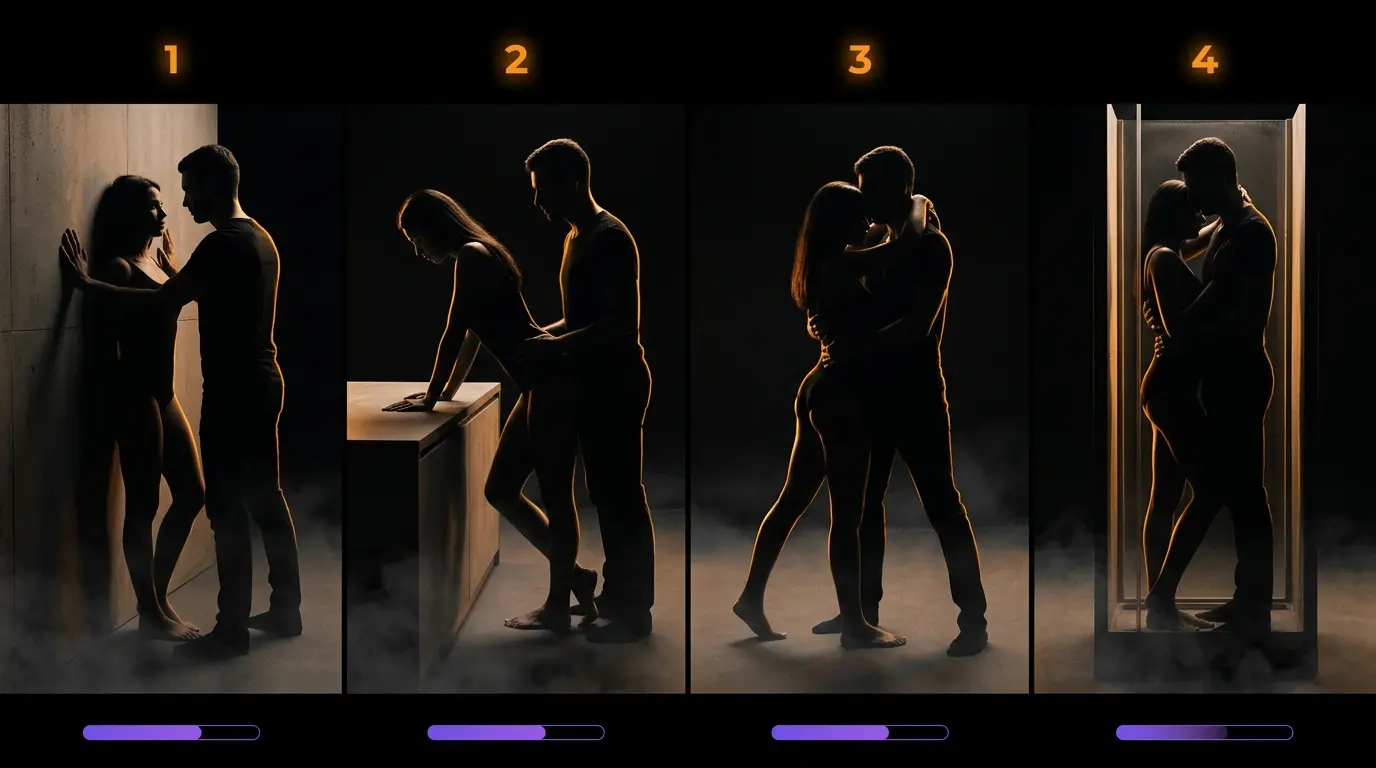
Scenario #1 — Wall-Braced (Easiest)
The receiver faces a structural wall, palms flat against the surface. By resting body weight against the wall, the receiver completely eliminates core stabilization demand.
For the giver: the immovable wall absorbs all forward kinetic energy from hip drive and arm motion — creating a perfectly rigid, closed-loop system. Maximum force, zero sway.
Scenario #2 — Furniture-Supported (Counter / Bed Edge)
The receiver hinges at the waist over a waist-high surface, bracing with upper body weight. This deep forward lean:
- Extends the gluteal region outward, reducing the arm’s reach distance
- Lowers the receiver’s vertical profile — resolving most height disparities naturally
- Creates a supported, stable foundation for vigorous, high-speed stimulation
Critical detail: The supporting surface must be waist-height. Too low forces dangerous lumbar flexion in the receiver; too high negates the postural advantage entirely.
Scenario #3 — Free-Standing (No Support)
Both partners rely entirely on internal proprioception and core strength. The combined center of mass fluctuates wildly during dynamic stimulation — requiring:
- Maximally widened stance from both partners
- Deeply bent knees to lower gravity
- Aggressive anchor arm engagement — non-negotiable in this scenario
- Continuous transversus abdominis activation
Without these adaptations, the rhythm collapses within seconds.
Scenario #4 — Shower Standing (Hardest)
The shower introduces two simultaneous threats:
Mechanical: Wet porcelain/tile eliminates floor friction, making a wide, stable stance precarious.
Physiological: Hot water triggers systemic vasodilation, causing blood to pool rapidly in lower extremities. Combined with standing posture, high arousal, and reduced cardiac return — this frequently produces orthostatic hypotension (fainting). This is a real clinical risk, not hyperbole.
Shower execution requires: lukewarm water (not hot), non-slip traction mats, actively bent knees at all times, brief duration, and strictly silicone-based lube.
| Scenario | Support Surface | Recommended Lube | Syncope / Fall Risk |
|---|---|---|---|
| #1 Wall-Braced | Vertical wall | Water-based or oil | 🟢 Very Low |
| #2 Furniture-Supported | Counter / Bed edge | Water-based or oil | 🟢 Low |
| #3 Free-Standing | None (muscular) | Water-based | 🟡 Moderate |
| #4 Shower Standing | Wet tile/tub | Silicone only | 🔴 High |
Body Type Adaptations
Height-Matched Partners
No artificial adjustment needed. Focus entirely on optimizing grip and establishing the hip-driven pendulum rhythm. Over-hip routing provides direct frenulum access without crossing the fatigue threshold.
6+ Inch Height Difference
Shorter giver: The arm must travel sharply upward, placing the wrist into extreme extension that compresses the carpal tunnel and exhausts forearm flexors rapidly. Fix: step stool elevation OR under-arm routing. The under-arm path sacrifices the ideal upward angle but spares the shoulder from impingement.
Taller giver: The spine compensates for downward reach with dangerous lumbar flexion. Fix: massively widened squat stance OR lean-forward setup to physically lower the receiver’s anatomical profile.
Larger Body Types
The primary barrier is spatial restriction — insufficient clearance for the arm to reach around. Fix: offset stance geometry. Instead of linear front-to-back alignment, the giver positions themselves to the left or right of the receiver’s midline, sliding into the natural contour of the hip. This dramatically reduces arm travel distance, bypassing the abdominal obstruction. Pair with the C-Clamp grip for maximum control with minimal lateral arm movement.
Common Standing Reach Around Mistakes
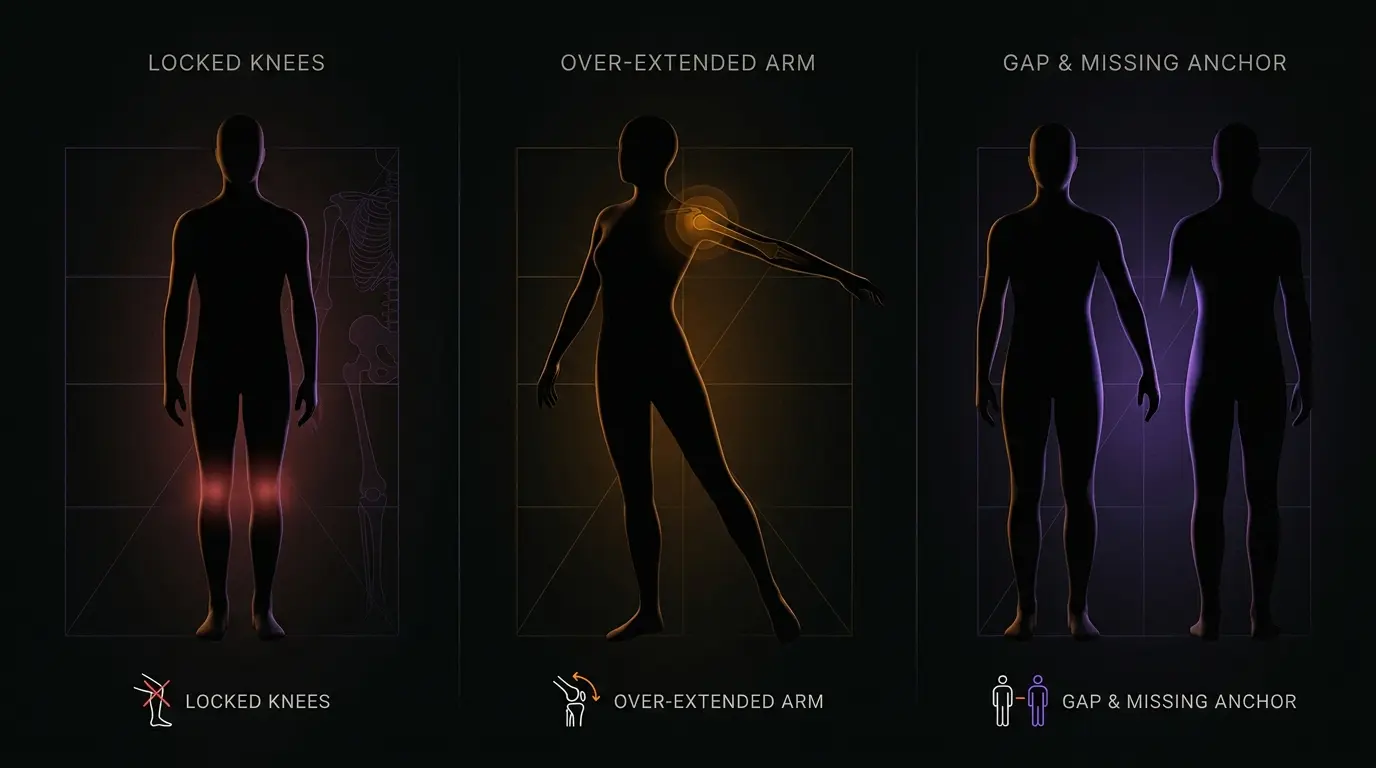
❌ Locking Both Knees
The most dangerous error. Locked knees render the calf muscle pump entirely non-functional — venous blood pools in lower extremities, cardiac output drops, and the brain is starved of oxygen. In a hot shower this triggers vasovagal syncope (fainting) and a catastrophic fall.
Fix: Keep knees softly bent at all times. Actively engage the calf muscles throughout the encounter.
❌ Over-Reaching Past Shoulder Limit
Extending the elbow past the 5 o’clock Home Zone forces the coracobrachialis to bear the full weight of the forearm horizontally — a guaranteed muscular seizure within minutes.
Fix: Pull the elbow back against the ribcage and close the physical distance by pressing hips tighter against the receiver. Reach with core, not arm extension.
❌ Skipping the Anchor Arm
Without the non-dominant arm locked around the receiver’s waist, both centers of mass remain independent. The kinetic energy of the handjob pushes the receiver forward — disrupting rhythm, breaking contact, and terminating the interaction abruptly.
Fix: The anchor arm is the structural foundation of the entire technique. It is never optional.
❌ Wrong Lube in the Shower
Water dissolves water-based lubricants within seconds, increasing friction catastrophically and causing micro-tears to sensitive epithelial tissue.
Fix: Silicone-based lube only in aquatic environments. Silicone molecules are hydrophobic — they actively repel water and maintain protective slip regardless of water flow.
→ Full breakdown of what goes wrong and why: Common Reach Around Mistakes.
💧 Shower-Safe Silicone Lube — Non-Negotiable
100% waterproof silicone formula. Never washes away. Rated 4.7/5 by verified buyers.
Shop Silicone Lube ➜Frequently Asked Questions
Is handjob standing up harder than spooning?
Yes — significantly. Spooning is passively supported: the mattress bears both partners’ weight, eliminating muscular fatigue almost entirely. Standing demands continuous core stabilization, active lower-body engagement for venous blood return, and precise shoulder mechanics. However, standing provides a unique upward pressure advantage and generates higher psychological arousal through the dominant posture and elevated cardiovascular engagement.
What surface works best for a standing reach around?
A waist-high, rigid surface that allows the receiver to lean forward fully — a sturdy countertop, heavy dresser, or firm bed edge. This furniture-supported configuration completely removes the receiver’s core stabilization demand, allowing the giver to apply vigorous, sustained friction without destabilizing the position.
How do you fix height difference during standing?
Match the fix to the gap: 2–6 inches difference → widen the stance. Giver significantly shorter → step stool or stair elevation. Giver significantly taller → lean-forward setup over furniture, or one-knee drop when no furniture is available. Each fix restores the ergonomic elbow Home Zone and prevents spinal compensation.
Can you do a standing reach around in the shower?
Physically yes — but the shower introduces orthostatic hypotension risk from hot water vasodilation combined with upright posture. Prerequisites: lukewarm water temperature, non-slip traction mats, actively bent knees throughout, brief duration, and exclusively silicone-based lube. Never attempt in a hot shower with locked knees.
How long can you sustain a standing handjob?
Duration correlates directly with elbow position. Elbow flared outward at “3 o’clock” → failure in under 10 minutes. Elbow tucked at “5 o’clock” with hip-driven rhythm and core engagement → sustained almost indefinitely with minimal strain. The reverse grip extends endurance furthest by maintaining neutral wrist alignment throughout.
Key Takeaways
Mastering the standing reach around requires treating the body as a cohesive kinetic unit, not an isolated arm. When the biomechanical principles are respected:
- Height disparity dissolves through stance widening, surface elevation, lean-forward setup, or the one-knee drop
- Arm fatigue is eliminated by anchoring the elbow at 5 o’clock and transferring stroke power from the hips and core
- Physiological risk (fainting, joint strain) is neutralized by active knee flexion, respiratory sync, and appropriate lube selection
- Stimulation intensity is maximized through the upward reverse grip targeting the frenulum — an advantage unique to the vertical stance
The technique shifts from a fatiguing struggle to a dominant, high-efficiency interaction when every joint, muscle, and surface in the kinetic chain is working in the same direction.
🎁 Complete Reach Around Starter Kit
Everything you need in one bundle — silicone lube, vibrating ring, and bullet vibrator. Free shipping on orders over $50.
Shop EdenFantasys ➜