In the context of physical intimacy, the biomechanics of the human body are almost always overlooked in favor of spontaneity. The result? Rapid forearm fatigue, wrist pain, dead arms, and experiences that end in frustration rather than mutual satisfaction. Most couples attempting a handjob from behind never consider that the angle of approach determines everything: the giver’s endurance, the quality of stimulation, and whether the session lasts 3 minutes or 30.
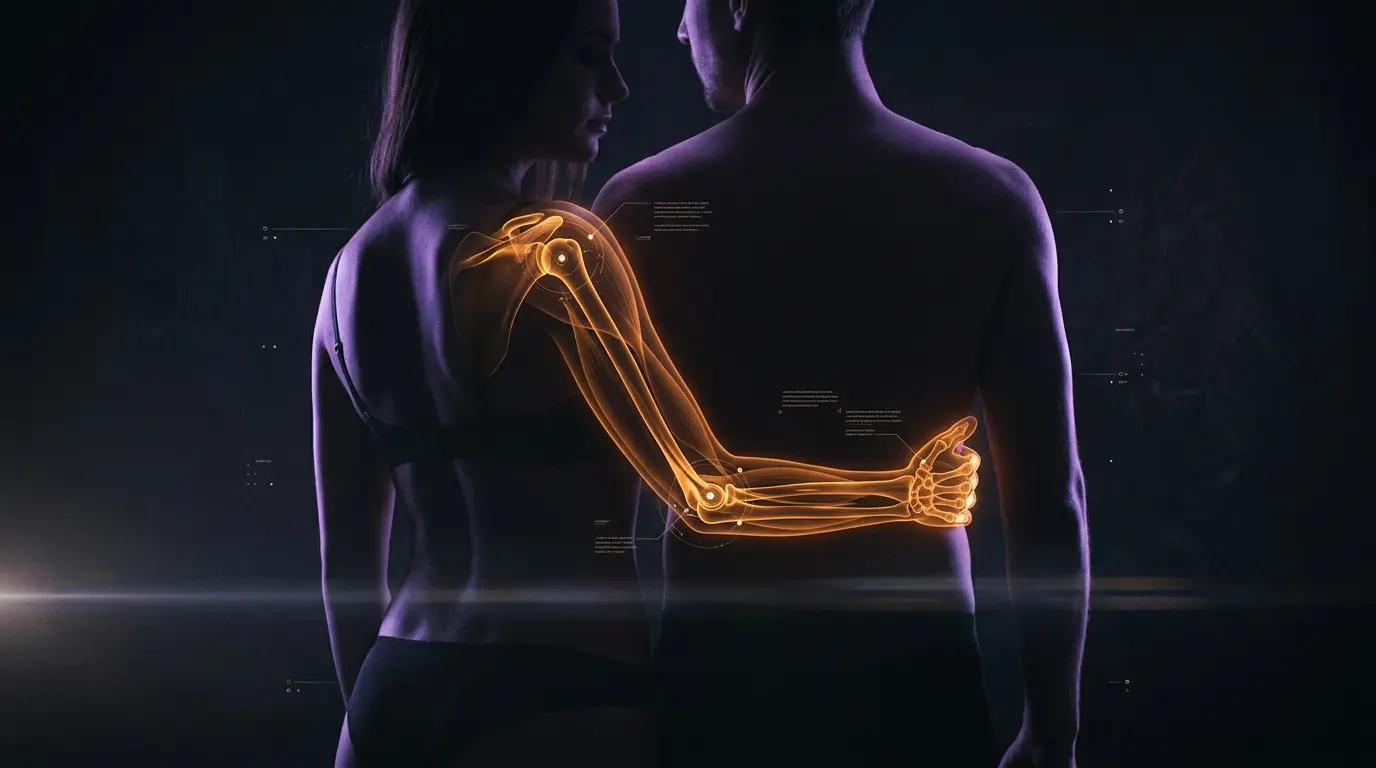
The problem is mechanical, not motivational. When the wrist is forced into extreme radial or ulnar deviation during repetitive motions, the flexor tendons become inflamed within minutes. The giver’s brain splits its attention between generating pleasure and managing pain signals from overloaded joints. Meanwhile, the receiver gets erratic, disconnected contact that plateaus arousal instead of building it.
This guide is the bridge. By applying biomechanical principles to six proven positions, you’ll eliminate the pain points that sabotage most reach around attempts. Every angle is analyzed for wrist alignment, muscle engagement, fatigue resistance, and targeted stimulation of the most sensitive nerve clusters.
For the foundational overview, see our Ultimate Guide to the Reach Around Handjob. For the complete step-by-step execution, read How to Give a Perfect Reach Around.
The Biomechanics of “Behind”: Why Angles Matter
The direction of your forearm relative to gravity plays a decisive role in how quickly muscles fatigue and how precisely you can target the anatomy. Advanced biomechanical simulations demonstrate that gravity’s effect is most pronounced when the hand operates horizontally, increasing extensor forces and out-of-plane kinematic errors compared to vertical orientations that leverage gravitational support.
In practical terms: the angle at which the giver’s forearm enters the space to reach the target directly determines when fatigue begins. Adopting a gravity-neutral orientation reduces muscle force variance and increases bone contact area, enabling smooth, sustained motion with minimal effort.
Weight distribution is equally critical. Keeping elbows close to the body (at a flexion angle between 90 and 120 degrees) while maintaining neutral head-to-torso alignment shifts the mechanical load from the small, easily fatigued forearm muscles to the larger, more resilient muscle groups of the shoulder, chest, and back.
| Wrist/Forearm Angle | Fatigue Rating | Pleasure Rating | Biomechanical Rationale |
|---|---|---|---|
| Excessive Radial Deviation | Very High | Low | Generates uneven pressure, increasing extensor forces and causing loss of motor control precision |
| Horizontal Neutral | Low | Very High | Optimal joint alignment reducing tendon stress, allowing precise and sustained cyclic motion |
| Ulnar Deviation | Medium | Medium | Causes flexor tendon strain and cumulative pressure leading to early numbness |
| Vertical Flexion | Very Low | High | Leverages gravity to reduce voluntary muscle effort and maximize joint contact area |
Position #1: The Spooning Reach Around (Best for Beginners)

Setup & Body Alignment
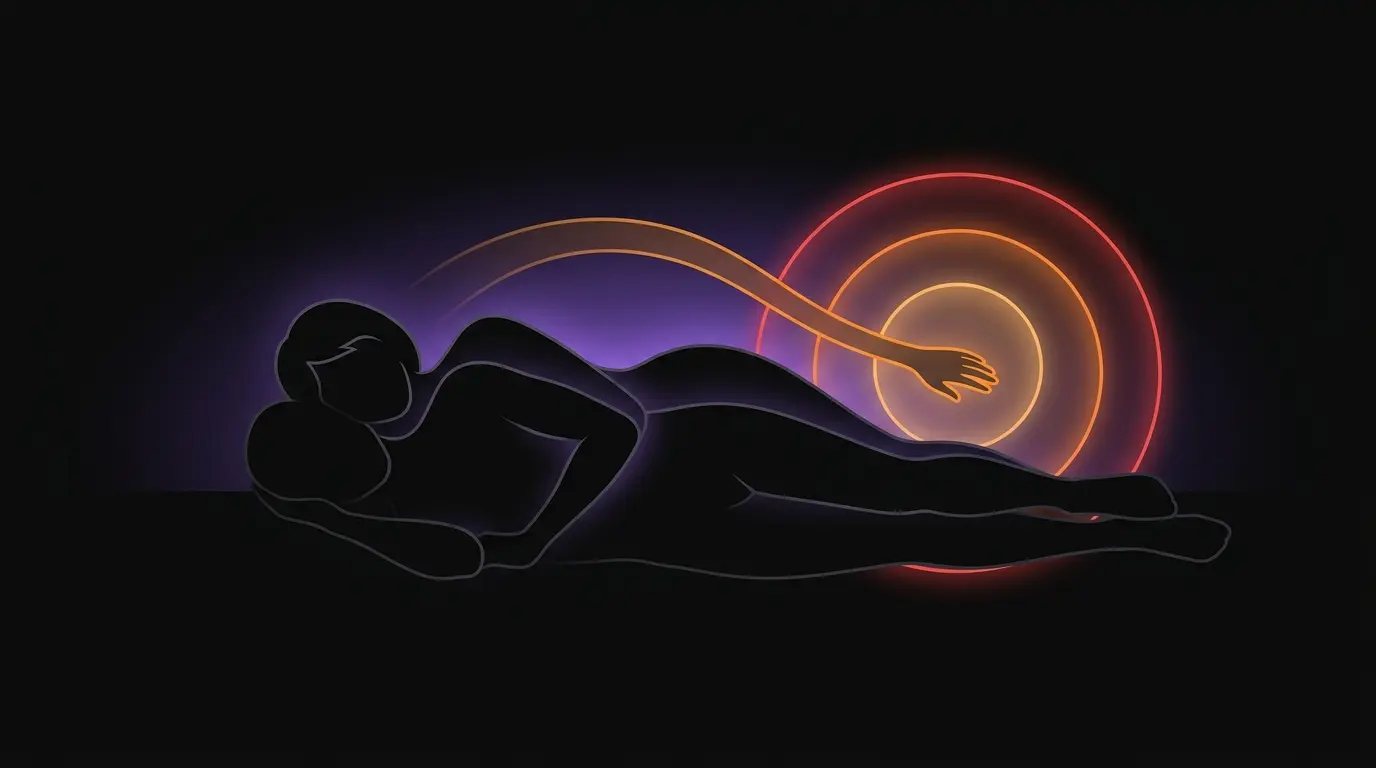
The lateral recumbent position maximizes total body contact while providing a stable, relaxed foundation. The receiver (the “little spoon”) lies on their side while the giver (the “big spoon”) aligns flush against the receiver’s posterior. This anatomical arrangement creates a wide support base that eliminates the need for core activation to maintain balance.
The critical challenge: managing the giver’s bottom arm. If trapped under the receiver’s body weight, it suffers vascular compression and brachial plexus nerve entrapment, causing painful numbness (paresthesia) that cuts sessions short.
Three proven solutions:
- Slide Behind — Slide the bottom arm behind your own back instead of under the partner. Maintains circulation and allows seamless position changes throughout the session
- Under-Neck Pillow Routing — Thread the arm through the natural gap between the receiver’s neck and mattress (the cervical lordosis creates a natural “tunnel” that doesn’t bear direct head weight)
- Wedge Pillow Propping — Use structural pillows to elevate both torsos slightly, creating a physical gap beneath the receiver where the arm rests freely without bearing any body mass
Optimal Wrist Angle & Grip in Spooning
With both partners lying on their sides, the giver’s top arm extends across the receiver’s waist at a horizontal neutral angle — naturally parallel to the bed surface. This eliminates the radial deviation that causes rapid forearm fatigue. By keeping the forearm parallel and avoiding excessive wrist flexion or extension, tension on the flexor carpi radialis is minimized, enabling sustained, precise, rhythmic motions based on physical feedback.
Explore all grip variations in Reach Around Grip Styles: Which One Works Best?.
Variations: Face-to-Face Spoon & Reverse Spoon
The Reverse Spoon has the receiver turning to face the giver while maintaining lower-body entanglement, creating entirely different stimulation angles and pressure dynamics. The Face-to-Face Spoon requires greater shoulder flexibility to reach around the torso but dramatically increases eye contact, synchronized breathing, and emotional synchronization alongside the neurological response.
Position #2: The Seated Floor Reach Around

Setup & Leg Positioning
Sitting on the floor provides an exceptionally wide, stable support base that radically reduces the need for core stabilization. The giver sits with legs extended (or cross-legged if hip flexibility permits) while the receiver sits between the giver’s legs, back resting fully against the giver’s chest. This continuous chest-to-back thermal contact allows the giver to respond immediately to the receiver’s breathing rhythm and body movement.
Upper-body stability is excellent in this configuration. The floor eliminates the possibility of imbalance, freeing the upper extremities to move with full efficiency along natural kinetic pathways, without the excessive spinal flexion that standing or unsupported bending would cause.
Why This Angle Hits the Frenulum Perfectly
This position offers a unique anatomical advantage. With the giver’s arms draping naturally downward from relaxed shoulders (gravity-assisted), a palm-to-ventral alignment is achieved. The frenulum — the most nerve-dense band of tissue on the ventral (underside) surface — aligns naturally with the giver’s palm and partially flexed fingers without requiring unnatural wrist rotation.
This anatomical match reduces ineffective friction and increases targeted pressure on the specific mechanoreceptors involved. Additionally, the position provides a visual feedback advantage — the giver can look directly over the receiver’s shoulder at the working area, allowing real-time adjustments to pressure, angle, and speed based on visible physiological responses.
Position #3: The Standing Reach Around {#standing-reach-around}

The Height Difference Challenge (And How to Solve It)
When executing the reach around while standing freely, height disparity between partners presents the most significant mechanical challenge. If the giver is significantly taller, excessive forward lumbar flexion is required to equalize height, creating enormous torque on the hip joints and lumbar vertebrae that leads to rapid fatigue and acute pain.
The solution: Stance Widening Technique (borrowed from powerlifting biomechanics):
- Widen lateral stance well beyond shoulder width — this effectively lowers the giver’s center of mass toward the ground without requiring knee flexion that strains the patellofemoral joint
- Calibrate knee bend slightly and deliberately to distribute remaining weight onto the stronger quadriceps rather than spinal ligaments
- Use architectural bracing — the receiver leans forward against a wall, sturdy furniture, or bed edge, creating a closed mechanical chain that eliminates balance demands from both partners’ stabilizer muscles
One-Arm Anchor Technique for Stability
Borrowed from nautical anchoring principles, the giver uses the non-dominant forearm to wrap firmly around the receiver’s waist, pulling gently toward the giver’s pelvis — known as body binding. This single-arm anchor creates a solid fulcrum point and prevents the random anterior-posterior oscillation caused by rhythmic motion.
The deeper advantage: reducing the receiver’s cognitive load. When the receiver feels their body is completely stabilized and supported without risk of losing balance, the central nervous system shifts toward parasympathetic dominance. The brain no longer allocates continuous processing power to spatial balance maintenance, enabling total immersion in the sensory experience.
Standing in the Shower: Special Considerations
The shower introduces a unique environment requiring strict logistical modifications:
Silicone lube is non-negotiable. Running water acts as a solvent that washes away water-based lubricants instantly. Silicone-based formulations are hydrophobic and maintain continuous protection of sensitive epithelial tissues from dry friction that causes painful micro-tears.
Non-slip safety is paramount. Install non-slip mats and pay extreme attention to weight distribution and directional pressure on slippery ceramic surfaces during movement.
For the right shower-safe lubricant, read Best Lubes for a Reach Around: 2026 Honest Review.
🏆 Best for Shower: Swiss Navy Silicone
100% waterproof, never washes away. Rated 4.7/5
Shop on EdenFantasys ➜Position #4: The Kneeling Reach Around
Setup (Receiver Standing, Giver Kneeling Behind)
This position creates a radical shift in height dynamics. The receiver stands (typically with anterior support on a wall or bed) while the giver kneels directly behind. The dramatic height disparity creates an unmistakable anatomical advantage: the upward angle advantage.
From the kneeling position, the giver’s hands and forearms are directed naturally upward, providing an exceptional targeting pathway to the glans and the entire ventral surface. This ascending angle isolates the motion path and allows deep access while drastically reducing the horizontal reach distance — minimizing mechanical fatigue and the counter-torques on the rotator cuff muscles.
Knee Comfort & Ergonomics
The primary mechanical weakness: enormous focal stress on the patellofemoral joint and surrounding tissues. Prolonged kneeling on hard surfaces causes acute compression that can lead to bursitis or joint pain.
The solution: High-density foam mats, cushioned blocks, or folded pillows beneath the knees distribute focal load across a wider area of the tibial surface.
Compared to the Seated Floor: While the seated position distributes weight safely across buttocks and posterior thighs (a large contact area), kneeling concentrates the entire mechanical load onto two small contact points (the knees). However, kneeling provides superior spatial freedom for the receiver to lean back and adjust depth dynamically — a kinetic advantage the seated position cannot match.
Position #5: The Reverse Reach Around

What Makes It “Reverse”?
The partners face each other (face-to-face), but instead of conventional anterior stimulation, the giver passes one or both arms around the receiver’s waist or back to reach the genital area from behind the body. This spatial arrangement creates novel grip angles that cannot be replicated in any other position. The thumb orients downward or inward rather than the standard upward position, imposing an entirely new sensory pattern on the receiver’s mechanoreceptors — creating a unique sensation of complete encirclement.
When to Use It (For Advanced Couples)
This position is classified as advanced due to exceptional biomechanical demands. It requires superior scapulothoracic flexibility for the giver to wrap without shoulder spasm, and high-level neuromuscular coordination to prevent excessive wrist torsion beyond the neutral zone.
Use it strategically when seeking intense visual contact and deep emotional connection (provided by facial proximity and direct expression reading) without sacrificing the unique physical sensation of posterior targeting.
Dive deeper in The Reverse Reach Around: A Complete Guide.
Position #6: The Edge-of-Bed Reach Around
Setup (Receiver on Bed Edge, Giver Behind)
The receiver lies on their back with the pelvis precisely at the bed’s edge, legs hanging comfortably off the side without muscular strain. The giver stands or kneels between or beside the receiver’s legs. This configuration achieves ideal spatial alignment — the giver adjusts their position to match the horizontal plane of the bed, creating a direct line of sight and work path that requires zero fatiguing spinal flexion.
This position provides unrestricted secondary zone access — the perineum, the base area, and inner thighs are all fully exposed and reachable simultaneously, enabling multi-dimensional stimulation.
Why This Is the “Power Position”
- Gravity assistance: Inspired by NASA’s zero-gravity bed engineering, lying with the hips at approximately 120 degrees distributes weight evenly, reduces lumbar pressure, and allows complete pelvic floor muscle relaxation. This deep relaxation eliminates the guarding reflex and increases tissue receptivity to stimulation
- Large muscle group engagement: The giver’s arm works with gravitational support downward and forward, shifting the kinetic burden from small forearm muscles to the larger, fatigue-resistant back and shoulder groups
- Superior visual access: The open angle provides unrestricted visual field of the entire target area, enabling real-time rhythm adjustments based on visible physiological responses (flushing, localized contractions)
Position Comparison Matrix
| Position | Difficulty | Fatigue Rating | Frenulum Access | Secondary Zones | Best For | Recommended Lube |
|---|---|---|---|---|---|---|
| Spooning | Low (Beginner) | Medium | Good | Limited | Long sessions, lazy mornings | Water-based thick or silicone |
| Seated Floor | Low | Very Low | Excellent | Excellent | Slow, deep, focused sessions | Premium water-based |
| Standing | Medium | Medium | Good | Good | Shower, quick dynamic sessions | Silicone (water-resistant) only |
| Kneeling | Medium | Low | Superior | Good | Precise upward-angle targeting | Water-based hybrid |
| Reverse | High (Advanced) | High | Medium | Limited | Intense eye contact + novelty | Water-based for easy cleanup |
| Edge-of-Bed | Low | Very Low | Excellent | Superior | Maximum climax intensity, full control | Any preferred type |
How to Transition Between Positions Smoothly
Maintaining continuous rhythmic contact during position changes is critical to avoiding sensory disruption and arousal regression. An abrupt stop causes rapid vascular decongestion and breaks the neurological flow state.
The “Handoff” Technique: Never break physical contact during transitions. While moving from standing to kneeling, or spooning to seated, one hand — or another body part (inner thigh, chest) — must remain in constant, steady contact with the receiver. This continuous tactile connection keeps peripheral nerve receptors activated and prevents the sudden arousal drop.
Non-verbal communication cues are equally vital. Rather than jarring verbal instructions, gentle directional pressure on the hip bones or a soft shoulder pull can guide the partner organically into the next position without breaking the mental state.
Master intimate communication in Bedroom Communication: Asking for a Reach Around Without Awkwardness.
Essential Gear for Every Position
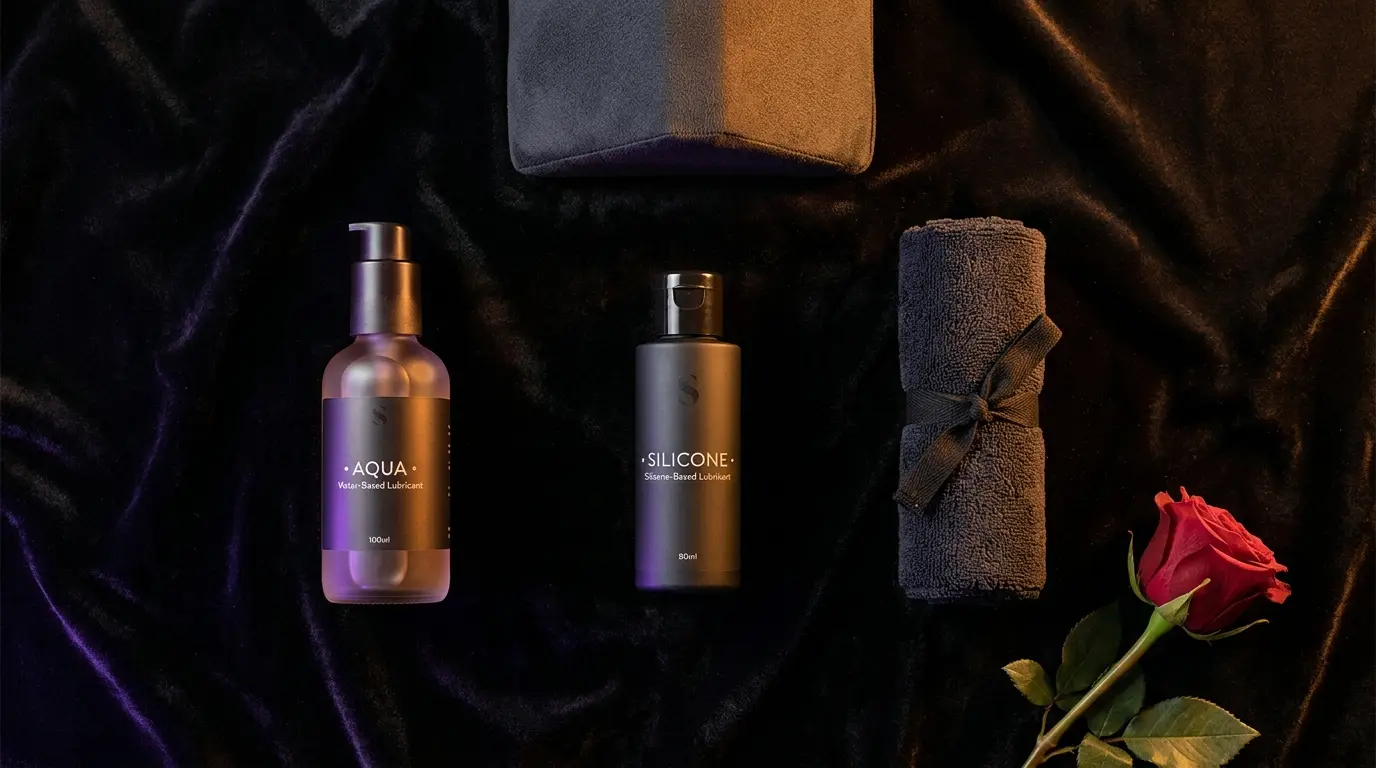
Lube selection by position and environment: The rheology (flow science) of lubricants directly affects the muscular effort required. Shower environments (standing position) demand water-insoluble silicone lubricants. Thick, viscous water-based formulations excel for edge-of-bed and spooning positions, resisting gravity and delivering comfortable glide that reduces the surface friction coefficient — and therefore the giver’s muscular strain.
Browse the complete comparison in Best Lubes for a Reach Around: 2026 Honest Review.
💧 Best All-Round Lube: EdenFantasys Personal
Works with all positions and toys. Rated 4.8/5. Only $9.99
Shop on EdenFantasys ➜Support pillows and wedges: Structural pillows are essential biomechanical intervention tools. They create anatomical gaps to prevent arm compression in spooning, provide lumbar support during floor positions, and maintain healthy neutral spinal alignment throughout extended practice.
Frequently Asked Questions
What’s the easiest reach around position for beginners?
Spooning is the most mechanically ideal choice for beginners. Since both partners lie on a supportive mattress, the muscular demands for balance and body weight support are virtually zero. This frees the brain to focus entirely on exploring hand movement and discovering comfortable angles without worrying about muscular fatigue. Apply the bottom-arm routing solutions (sliding behind your back or under the neck pillow) to prevent the numbness that disrupts sessions.
New to this? See our complete Reach Around for Beginners: Everything You Need to Know.
Can you do a reach around while standing in the shower?
Yes — with strict adherence to safety rules and biomechanical principles for slippery environments. Apply the stance widening technique to lower the center of gravity and reduce lumbar torque. Silicone lubricant is physiologically mandatory, not optional, because water immediately strips away water-based formulations, exposing tissue to painful dry friction and micro-tears.
Which position gives the best access to the frenulum?
The Seated Floor and Kneeling positions dominate in this anatomical category. The seated position provides a natural ventral approach that matches palm curvature without requiring wrist strain. The kneeling position leverages height disparity to deliver a sharp ascending angle that strikes the frenulum directly with every upward stroke, stimulating the dense nerve endings with minimal horizontal effort.
How do I avoid my arm going numb during spooning?
Numbness (paresthesia) results from direct mechanical compression of blood vessels and brachial plexus nerves. Never place the bottom arm directly under the receiver’s heavy torso. Three engineering solutions: thread the arm safely under the receiver’s head pillow (exploiting the cervical gap), slide it behind your own back, or use a wedge pillow to elevate the receiver’s torso a few degrees and create a structurally empty space where the arm rests freely.
Key Takeaways
The science of reach around positions is biomechanics, not guesswork:
- Horizontal neutral wrist alignment reduces forearm muscle drain and extensor forces by the largest margin — avoid radial or ulnar deviation at all costs
- Bottom arm management in spooning requires spatial awareness — use pillow routing or wedge elevation to prevent brachial plexus compression and numbness
- Gravity is your ally at the bed edge — the 120-degree hip angle relaxes pelvic floor muscles and eliminates the giver’s lifting burden, extending endurance dramatically
- Height compensation when standing demands stance widening (borrowed from powerlifting) to lower the center of mass and relieve lumbar torque for the taller giver
- The single-arm anchor (body binding) reduces the receiver’s cognitive load by providing absolute physical stability, enabling deeper parasympathetic nervous system engagement
- Support gear is not optional — foam kneeling mats, lumbar wedges, and position-appropriate lubricants are engineering requirements for joint safety and tissue protection
Ready for the full technique breakdown? Return to our Ultimate Guide to the Reach Around Handjob for all techniques, tips, and product reviews.
Master the rhythm and grip for any position: Read our Step-by-Step Guide: How to Give a Perfect Reach Around.
Need the right lubricant for your preferred position? See our Best Lubes for a Reach Around: 2026 Honest Review.
🛒 Shop Our Top Picks on EdenFantasys
Premium lubricants, toys, and wellness essentials. Free shipping on orders $59+
Browse the Full Collection ➜Watch real positions in action: Browse our curated HD video library.