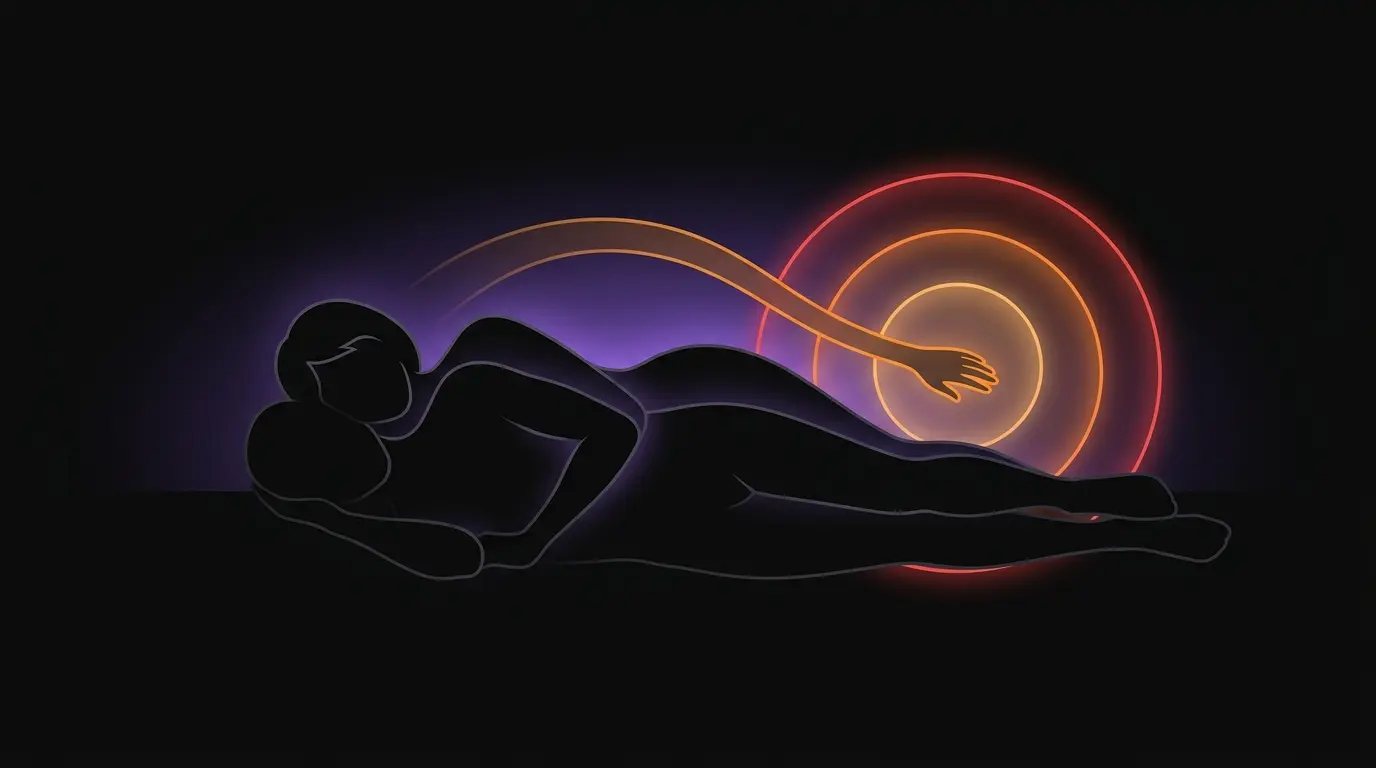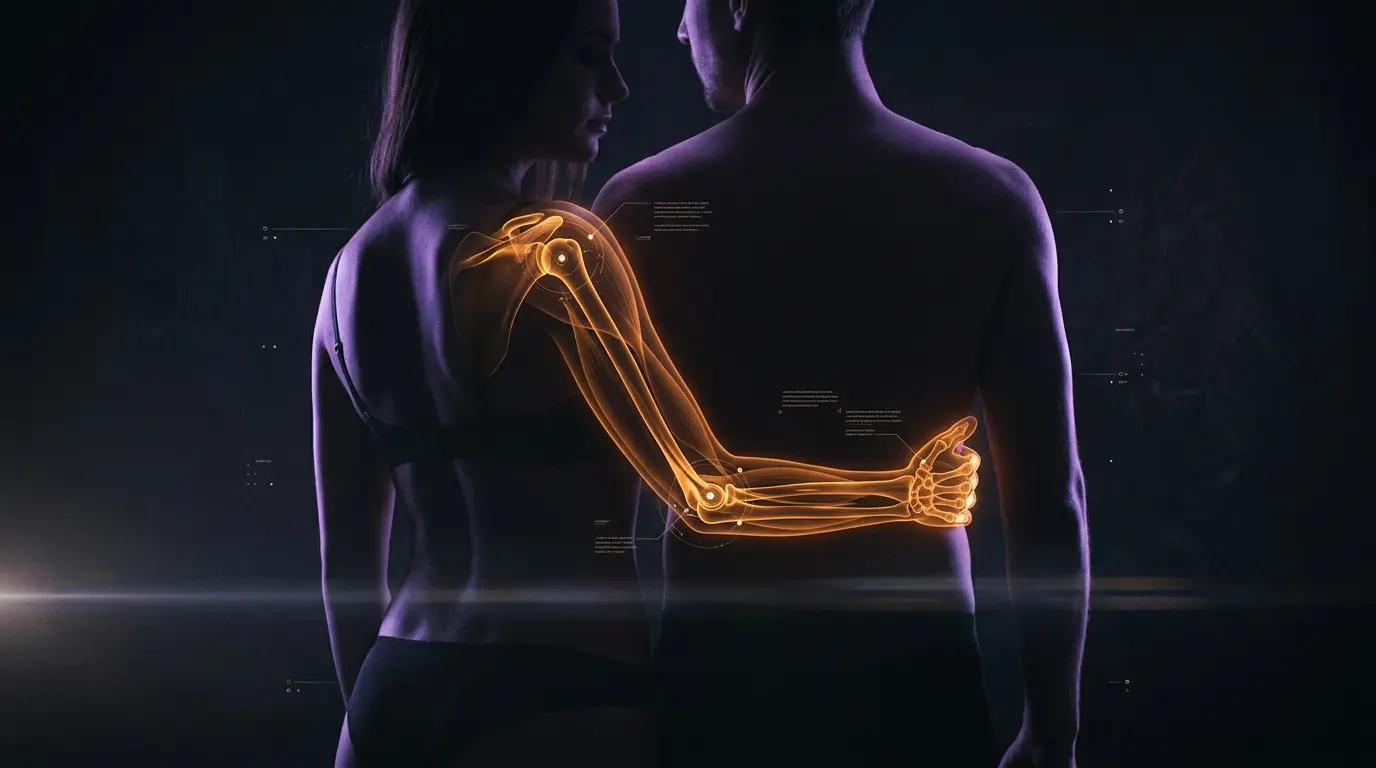
Learning how to give a hand job from a dorsal (behind) approach can feel deeply unnatural the first time. The mechanics of the reach around handjob require a complex understanding of spatial geometry, tissue response, and rhythmic consistency that standard frontal stimulation simply does not demand. Without foundational knowledge, beginners battle misaligned wrists, uncoordinated movements, and a complete lack of spatial awareness.
Here’s the truth nobody tells beginners: the success of this technique relies less on wrist speed and entirely on tactile feedback, positional stability, and anatomical precision.
This guide is your complete roadmap from total confusion to confident execution. By the end, you will understand exactly what to touch, how to position yourself, and how to read your partner’s response in real time.
For the complete advanced reference covering all skill levels, see our Ultimate Guide to the Reach Around Handjob.
What Exactly Is a Reach Around? (And Why It Works)
A reach around is the specific act of providing manual penile stimulation while positioned behind the receiving partner. This interaction can occur while spooning, seated, or standing upright.
The biomechanical angle creates a highly specific friction profile that differs fundamentally from frontal stimulation. The reach naturally shifts the primary contact points from the top side of the penis to the ventral (underside) structures, which house entirely different sensory receptors.
Why does this position work so well psychologically?
Being physically enveloped from behind signals a protective, encompassing closeness that many individuals find deeply arousing on a subconscious level. This posture removes the cognitive load of maintaining direct eye contact, allowing the receiver to turn their focus entirely inward and heighten their perception of physical touch.
Simultaneously, the giving partner benefits from an expansive, encompassing physical position that naturally increases feelings of confidence and control. The giver operates from a position of stability while the receiver benefits from the relaxation of visual privacy, creating an optimal feedback loop for arousal.
Quick Anatomy Primer: Know What You’re Touching
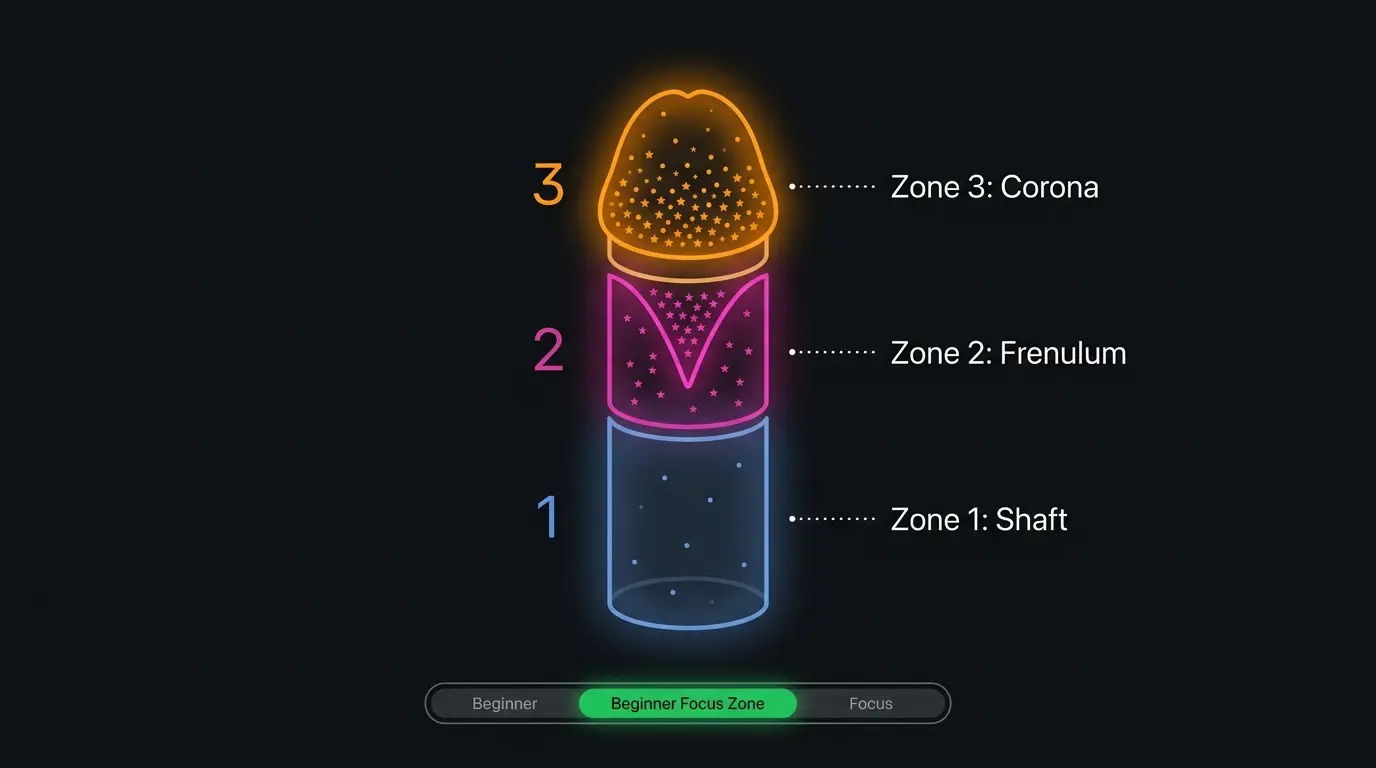
The penis is not a uniform structure. Its distinct anatomical zones contain vastly different densities of nerve endings and respond to specific types of mechanical pressure.
The Shaft (Where Most Beginners Stay)
The shaft comprises the primary erectile cylinders that engorge with blood during arousal to provide structural rigidity. The skin here is highly mobile, acting as a sliding sheath over the underlying tissue. Because the shaft covers the largest surface area, it naturally becomes the default grip zone for beginners. However, remaining exclusively focused here ignores the highly sensitive terminal structures necessary to trigger climax.
The Frenulum (The Hidden Power Zone)
The frenulum is a V-shaped band of tissue located on the underside of the penis, precisely where the glans (head) meets the shaft. Neurologically, it is the absolute focal point of sexual sensation, densely packed with specialized Pacinian receptors that respond to vibration, micro-pressure changes, and light touch. Stimulation here requires minimal force: light tapping, focused tracing, or targeted rhythmic pressure can produce responses far exceeding standard shaft stroking.
The Glans and Corona (The Finish Line Zone)
The glans is the most heavily innervated region, often compared directly to the clitoris in terms of nerve density. The corona is the flared ridge at the base of the glans where it meets the shaft. These areas respond acutely to temperature changes, moisture, and targeted circular friction. Because the mucosal skin over the glans lacks its own natural lubrication, direct dry friction must be avoided to prevent micro-abrasions and discomfort.
For a detailed analysis of what happens when these zones are neglected, see 5 Common Reach Around Mistakes.
What You Need Before You Start (Essential Checklist)
Lubricant (Non-Negotiable)
External lubrication is strictly mandatory. The penile skin, particularly around the glans and frenulum, is highly susceptible to mechanical stress. Inadequate lubrication leads directly to micro-tears in sensitive tissue, delayed climax, and significant post-session discomfort.
A high-quality lubricant fundamentally alters the touch, allowing the hand to glide seamlessly over the coronal ridge without dragging or causing painful traction.
| Feature | Water-Based | Silicone-Based |
|---|---|---|
| Texture | Lightweight, natural, absorbs over time | Ultra-slick, sits on top of the skin |
| Longevity | Short to moderate; requires reapplication | Extremely long-lasting |
| Water Resistance | Washes away instantly | Highly waterproof (shower-safe) |
| Cleanup | Simple warm water rinse | Requires soap |
| Compatibility | Safe with all toys and materials | May degrade silicone toys |
For detailed product comparisons, see Best Lubes for a Reach Around: 2026 Honest Review.
🌿 Budget-Friendly Beginner Pick: EdenFantasys Personal Lube
Water-based, pH-balanced, toy-safe. Perfect for your first session. Rated 4.6/5
Shop on EdenFantasys ➜Clean Hands and Trimmed Nails
Hands must be thoroughly washed and nails meticulously trimmed before any genital contact. The biomechanical angle of the reach around naturally places fingertips in direct, sustained contact with the sensitive ventral shaft and frenulum. Smooth, well-maintained fingertips ensure pressure is distributed evenly without causing localized scratching or discomfort.
Optional: Enhancement Tools
For individuals looking to augment the experience, vibrating rings or finger vibrators can transmit deep, low-frequency vibrations directly to the Pacinian corpuscles in the frenulum. These tools rapidly elevate baseline neurological arousal without requiring excessive manual effort.
How to Give a Reach Around: Step by Step for Beginners
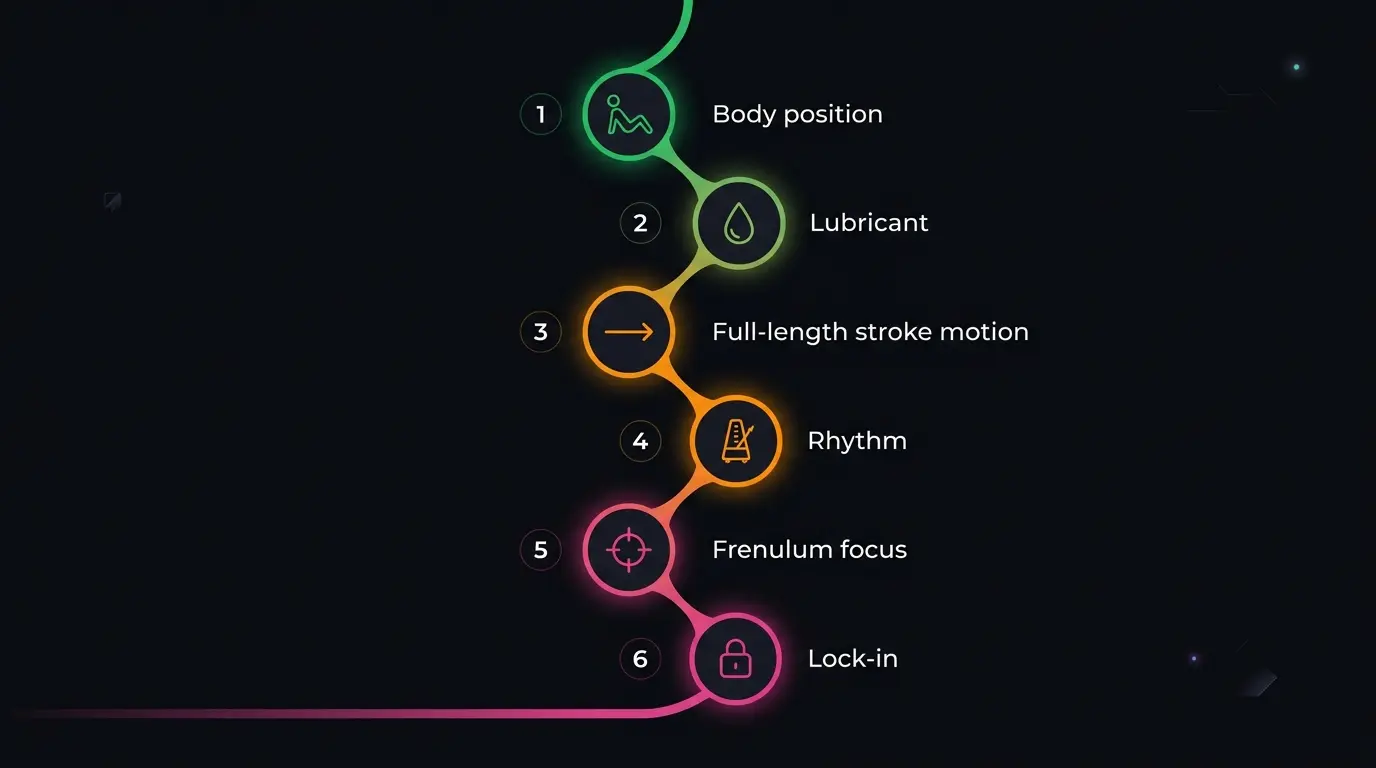
Step 1: Get Into Position
Establish a stable, ergonomic physical geometry. The two most effective starting postures are lying on your side (spooning) or seated directly behind your partner. In either configuration, your stimulating arm must have an unobstructed path to the pelvic region without over-extending the shoulder or hyper-flexing the wrist.
For precise positional breakdowns, see Reach Around From Behind: Positions and Angles.
Step 2: Apply Lubricant
Apply a generous pool of lubricant directly into your palm before making contact. Using a pump-action bottle allows seamless one-handed reapplication without breaking rhythm or losing physical contact.
Step 3: Start with the Full-Length Stroke
Wrap your lubricated hand around the base of the shaft. Initiate a remarkably slow, deliberate stroke from base to tip and back down. The primary objective during this initial phase is not intense arousal but rather mapping the spatial angle and distributing lubricant evenly across the entire surface.
Step 4: Find a Rhythm (Not Speed)
This is where most beginners panic:
Inexperienced individuals frequently default to rapid, erratic movements under the assumption that maximum speed equals maximum pleasure. In reality, the central nervous system responds far more effectively to predictable, rhythmic consistency than to chaotic velocity.
Establish a strict metronomic pace: approximately one to two complete strokes per second. This steady frequency allows the receiver’s nervous system to anticipate the sensory input, facilitating deeper muscular relaxation and heightened arousal.
Step 5: Add Frenulum Focus
Once baseline rhythm is established, shift the hand placement slightly. Allow the thumb or index finger to rest against the ventral side, just below the head. Employ the “texting fingers” method: using light, deliberate pressure, tap and glide the pad of the thumb over the V-shaped frenulum in a motion similar to typing on a smartphone. This concentrated stimulation acts as a rapid neurological accelerator for the entire arousal curve.
Step 6: Read the Signs and Lock In
An approaching orgasm is signaled by specific, involuntary responses: sharply increased breathing, profound muscular tension in the thighs and abdomen, and involuntary vocalizations or breath-holding.
When these indicators appear, the absolute rule is to lock in. Do not alter the speed, grip pressure, stroke length, or angle. The nervous system relies entirely on that specific, established sensory loop to reach the threshold of climax.
For a comprehensive breakdown of why changing technique at the finish line destroys the experience, see 5 Common Reach Around Mistakes.
Your First Time Protocol (Beating the Nerves)
It’s OK to Be Slow
The neurological receptors in the glans and frenulum do not require high-velocity friction to register overwhelming pleasure. Operating at a slow, deliberate pace allows you to dedicate cognitive resources entirely toward maintaining correct wrist angle and grip tension. Prioritize quality of sensation over raw speed for a pain-free, sustainable experience.
Communication Is Your Superpower
Because you are operating from behind, direct visual feedback regarding facial expressions is severely limited. Clear verbal communication becomes the primary mechanism for sensory calibration. Use continuous, non-intrusive feedback loops: “Does this pressure feel right?” or “Is this pacing good?”
This verbal bridging eliminates guesswork and guarantees that your mechanical inputs align with the receiver’s real-time preferences.
What to Do If You Lose Rhythm
Muscular fatigue or a sudden shift in posture can cause an immediate break in rhythm. When this happens, halt completely. Pause, execute a generous reapplication of lubricant, and methodically re-establish the correct grip and posture. Resuming with fresh lubrication and a corrected posture is infinitely preferable to continuing with a compromised, awkward angle that leads to mutual discomfort.
3 Best Positions for Beginner Reach Arounds
#1 The Spoon (Easiest)
Both partners lie flat on their sides, facing the same direction, with the giving partner encompassing the receiver closely from behind. The stimulating arm drapes naturally over the receiver’s hip, providing an ergonomic, downward-sloping angle for the wrist. To avoid “dead arm” syndrome, position the bottom arm tucked beneath your own head or extended flat under the pillow.
#2 Seated Behind (Most Control)
The receiver sits back between the straddled legs of the giver, who acts as a solid, stabilizing backrest. This position grants exceptional physical leverage, bilateral stability, and unrestricted pelvic access. Psychologically, it facilitates intense proximity while avoiding the pressure of facial eye contact, dramatically reducing performance anxiety.
#3 Standing Embrace (Adventurous Beginner)
Executed while standing upright, often in a shower environment. The receiver leans back against the giver’s chest. If height disparity exists, the taller partner adopts a widened stance or slight squat to align pelvic regions. Maintain “soft” knees to absorb motion and prevent lower back strain. This position provides unparalleled access for deep, full-length strokes.
For the complete positional guide, see Reach Around From Behind: Positions and Angles.
🏆 Premium Pick: Swiss Navy Silicone Lube
Ultra long-lasting, waterproof, perfect for shower sessions. Rated 4.7/5
Shop on EdenFantasys ➜Beginner Grip Styles (Start Here)
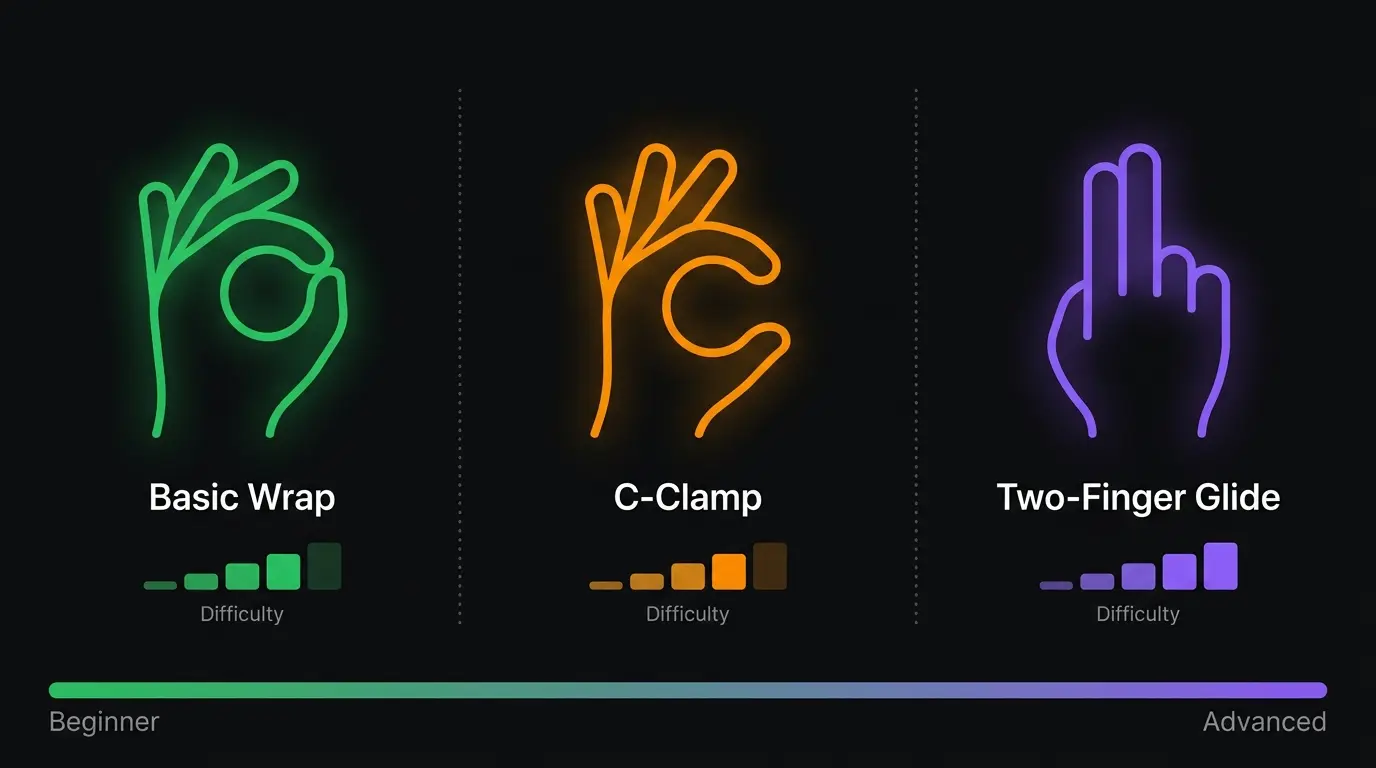
The Basic Wrap
The entire palm and digits gently encircle the shaft with relaxed, even tension. This grip maximizes skin-to-skin contact, providing a broad, comforting sensation. It is the ideal starting point for distributing lubricant and establishing initial rhythm.
The C-Clamp
The thumb and index finger form a controlled ring around the upper shaft, positioned directly beneath the coronal ridge. The remaining fingers rest loosely along the base. This grip allows exact modulation of pressure, maintaining intense focus on the most neurologically sensitive upper zones.
The Two-Finger Glide
A minimalist technique using only the index and middle fingers, heavily lubricated, pressed gently against the underside of the shaft. Using a feather-light touch, the digits trace slow, linear paths along the frenulum band. This grip is remarkably effective during the pre-climax plateau (edging) to build intense, localized tension without pushing the receiver over the edge.
| Grip Style | Difficulty | Pressure Profile | Best Use Case |
|---|---|---|---|
| Basic Wrap | Low | Broad, ambient, even distribution | Initial arousal, spreading lubricant, establishing rhythm |
| C-Clamp | Medium | High at the top, loose at the base | Modulating intense friction, focusing on the corona |
| Two-Finger Glide | Medium-High | Pinpoint, feather-light | Frenulum targeting, edging, extreme localized sensitivity |
Common Beginner Mistakes (Quick Reference)
- Operating with excessive dryness: Friction damages tissue. Fix: apply lubricant every few minutes to prevent dermal dragging and micro-tears
- The “Jackhammer” velocity effect: Chaotic speed kills arousal. Fix: establish a metronomic pace of one to two strokes per second
- Neglecting the ventral hotspots: The shaft alone is not enough. Fix: deliberately target the frenulum using the texting fingers method
- Shifting technique near climax: The brain needs consistency to finish. Fix: when orgasm indicators appear, maintain absolute consistency in grip, pressure, and speed
- Poor wrist alignment causing fatigue: Pain ruins the mood. Fix: re-evaluate your position to ensure the arm is not operating at an awkward angle
For the comprehensive deep-dive on each mistake, see 5 Common Reach Around Mistakes (And How to Fix Them).
When to Add Tools (Level Up After the Basics)
Once pure manual proficiency and rhythmic consistency are achieved, the introduction of mechanical enhancement tools can exponentially increase sensory output. The most effective beginner upgrade is localized vibration.
Because the dorsal reach around leaves the back of the giving hand exposed, slipping a vibrating ring over the index and middle fingers easily transfers oscillating energy directly through the hand and into the penile tissue. When applied to the frenulum, the mixing of vibration frequencies triggers an incredibly intense response from the mechanoreceptors, often producing a uniquely powerful climax.
💍 Easiest Beginner Upgrade: His and Hers Vibrating Ring
Hands-free vibration for both partners. Only $9.99. Rated 4.5/5
Shop on EdenFantasys ➜Frequently Asked Questions
Is a reach around hard to learn?
Not at all. Mastery relies far more on spatial awareness and positioning than complex manual dexterity. Once the wrist angle is properly corrected through ergonomic positioning, the technique quickly becomes highly intuitive and mechanically efficient for both partners.
What lube should a beginner use for a reach around?
A high-quality, glycerin-free water-based lubricant is universally recommended for initial attempts. It is safe for all skin types, compatible with latex, and washes away easily. For extended sessions or shower encounters, upgrade to a medical-grade silicone lubricant for superior longevity and waterproofing.
How do I know if my partner likes what I’m doing?
Look for autonomic responses: quickened breathing, spontaneous muscular contractions in the abdomen and thighs, and involuntary vocalizations. Establishing a continuous verbal feedback loop (“Does this feel good?”) eliminates all guesswork.
How long should a reach around last?
There is no strict requirement. Most sessions range from 5 to 20 minutes depending on arousal level. With correct ergonomic technique, sessions can comfortably extend to 30 minutes or more, especially when pacing is deliberately slowed to explore frenulum and coronal nuances.
Can I give a reach around if I’m left-handed?
Absolutely. When spooning, the left-handed giver should position themselves on the right side of the bed to allow the dominant left arm to drape naturally over the receiver’s hip. In seated positions, use an “inside-out” approach where the dominant arm reaches around the lower flank rather than over the high shoulder, preventing awkward wrist contortions and maximizing leverage.
Key Takeaways for Beginners
- Target the Anatomy: Move beyond the shaft to deliberately stimulate the highly dense nerve clusters of the glans, corona, and V-shaped frenulum for dramatically intensified response
- Lubrication is Mandatory: Liberal application of water-based or silicone-based lubricant is a non-negotiable requirement to prevent tissue damage and enhance the quality of touch
- Slower is Better: Discard chaotic, high-velocity movements in favor of a slow, deliberate pace that allows precise tactile mapping of the anatomy
- Rhythm Over Speed: The central nervous system craves predictability. Establish a consistent, uninterrupted metronomic pace so the receiver can fully surrender to the sensation
- Communicate Constantly: Operating from behind removes visual cues, making ongoing verbal communication your primary tool for adjusting grip and intensity
- Embrace the Position: The encompassing dorsal posture naturally generates a powerful psychological dynamic of security, confidence, and profound emotional intimacy
Ready for advanced techniques? Return to our Ultimate Guide to the Reach Around Handjob for the complete deep-dive.
Master the full execution protocol: Read How to Give a Perfect Reach Around: Step by Step.
Learn the 5 critical errors to avoid: See 5 Common Reach Around Mistakes (And How to Fix Them).
🛒 Shop Beginner Essentials on EdenFantasys
Premium lubricants, vibrating rings, and enhancement tools. Free shipping on orders $59+
Browse the Full Collection ➜Watch real techniques in action: Browse our curated HD video library.