The structural and anatomical positioning required to administer manual stimulation from a posterior angle shifts the mechanical load entirely across the upper extremities. When partners face one another, the providing partner naturally relies on a neutral wrist alignment and straightforward elbow flexion, allowing the larger muscles of the upper arm and chest to drive the longitudinal stroking motion effortlessly. However, shifting behind the receiving partner fundamentally alters this spatial relationship — the providing partner is forced to maneuver the forearm and wrist into extreme degrees of rotation merely to make contact, immediately introducing a complex set of biomechanical challenges.
This guide teaches women how to give a great hand job from behind using biomechanical principles that maximize his pleasure while minimizing her fatigue.
→ New here? Start with the Ultimate Guide to the Reach Around Handjob. → Master the fundamentals: How to Give a Perfect Reach Around.
Why Giving a Handjob From Behind Is Different
The Wrist Angle Problem — Face-to-Face vs Behind
The human forearm allows for two fundamental rotational movements: pronation (palm downward or backward) and supination (palm upward or forward). The radius bone physically rotates around the relatively stationary ulna to accomplish this.
In a standard face-to-face encounter, the giving partner’s wrist remains neutral and relaxed. The primary axis of passive wrist motion follows the “dart thrower’s motion,” moving seamlessly from radial extension to ulnar flexion. Conversely, executing a reach around requires the providing partner to lock the forearm into either maximum pronation (overhand grip from behind) or maximum supination (underhand grip from behind).
Maintaining maximum supination or pronation under continuous tension places the wrist at a severe mechanical disadvantage. The constant isometric contraction of the pronator teres, pronator quadratus, or supinator muscles — paired with the application of friction — leads to rapid lactic acid accumulation. This sustained, unnatural torque is the primary physiological reason the posterior approach feels mechanically awkward without proper form correction.
Why the Reach Around Is Harder for Women (And How to Fix It)
Standard anatomical discrepancies make the reach around specifically challenging for female partners. Differences in average arm length, shoulder width, and baseline grip strength mean that reaching completely around a male partner’s torso can severely overextend the shoulder capsule.
Clinical biomechanical studies demonstrate that wrist and forearm fatigue occurs significantly faster when the hand is placed in horizontal orientations compared to vertically aligned downward orientations. To mitigate this strain:
- Close the proximity gap — press the chest firmly against his back to minimize reach distance
- Abandon isolated wrist flexion — lock the wrist joint rigidly and initiate stroking from the elbow and shoulder complex
The Advantage Women Have From Behind
Despite the biomechanical hurdles, the posterior approach offers unparalleled advantages:
- Full-body contact — breast-to-back pressure stimulates dorsal nerve endings, creating multi-layered sensory amplification
- Element of surprise — the receiving partner cannot visually anticipate timing, pressure, or trajectory, spiking dopamine continuously
- Free secondary hand — unrestricted access to the entire body transforms a localized act into a comprehensive somatic event
- Female-led dynamic — the providing partner entirely dictates pace, angle, and intensity
| Metric | Face-to-Face | From Behind (Reach Around) |
|---|---|---|
| Primary Grip Style | Neutral to slight supination | Extreme pronation or supination |
| Wrist Alignment | Linear, parallel to shaft | Oblique or perpendicular |
| Provider Fatigue | Low to Moderate | High (if distal), Low (if core-driven) |
| Power Dynamic | Mutual, conversational | Female-led, dominant, visually surprising |
| Secondary Hand Utility | Limited by torso interference | Unrestricted access to entire body |
→ All position angles: Reach Around From Behind: Positions and Angles.
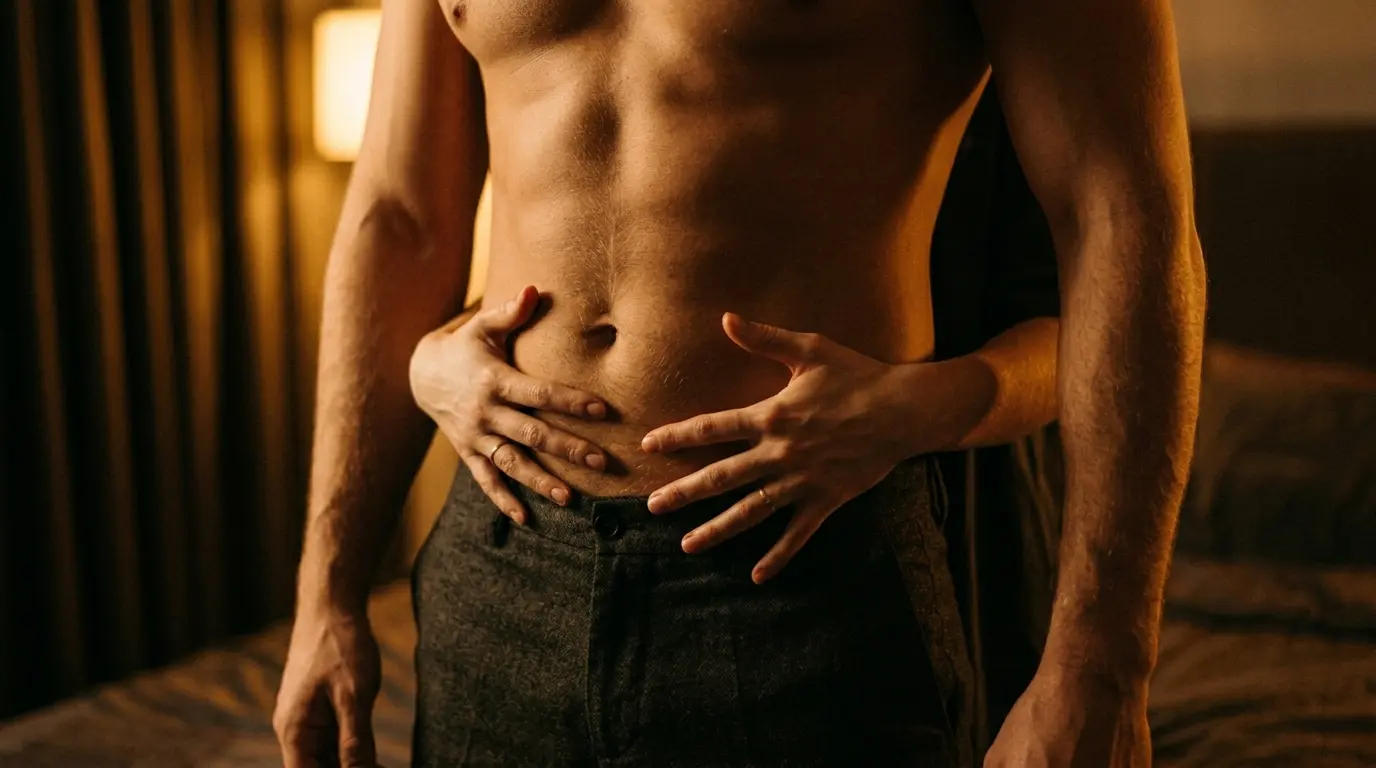
Step-by-Step: How to Give a Good Hand Job From Behind
Step 1 — Positioning Your Body (Spooning, Standing, Seated)
Before any manual contact occurs, optimal structural alignment must be established:
- Spooning — align your pelvis directly behind his. The providing arm rests on his upper hip, offloading weight and reducing deltoid strain
- Standing — use a staggered stance (one foot forward) to generate kinetic power from the lower body
- Seated — sit upright while he reclines against your chest, presenting the pelvic region at an optimal upward-facing angle
Step 2 — Finding the Right Grip Angle
From behind, consciously choose between:
- Overhand grip (maximum forearm pronation, palm facing inward) — more intuitive from standing or seated positions, fingers curl naturally for downward strokes
- Underhand grip (maximum forearm supination, palm facing upward) — highly effective in spooning, naturally aligns the thumb directly with the frenulum
The optimal choice depends on which position allows you to lock the wrist joint and rely predominantly on elbow flexion.
Step 3 — The First 30 Seconds (How to Start)
The initial thirty seconds must be dedicated exclusively to sensory habituation. Begin with light, non-restrictive touch — tracing the inner thighs, the pubic mound, and the perineum before transitioning to a full grip.
Applying generous lubricant during this window is non-negotiable. Lubrication alters the friction mechanics, allowing the hand to glide smoothly without dragging sensitive tissue. This reduces the force required, subsequently lowering the exertion demanded of your forearm muscles.
Step 4 — Building the Rhythm (SPM Guide for Women)
Utilize a deliberate, progressive wave methodology:
- Initiate at ~40 SPM — slow, methodical strokes with firm base pressure and lighter glans pressure
- Escalate to ~80 SPM — as his breathing and muscle tension indicate rising arousal
- Decelerate to ~40 SPM — once he nears the plateau phase
This rolling fluctuation mimics edging, vastly compounding climax intensity.
Step 5 — Using Your Other Hand Simultaneously
The posterior orientation liberates the secondary hand. Deploy it to:
- Gently cup and apply mild traction to the testicles
- Apply light, rhythmic pressure to the perineum
- Trace the chest and tease the nipples
- Run nails down the spine
Because he cannot visually track the secondary hand, the unpredictable nature of this stimulation triggers continuous dopamine and adrenaline release.
| Step | Hand Position | Speed | His Response |
|---|---|---|---|
| 1. Positioning | Arm resting on hip/torso | Static | Parasympathetic relaxation |
| 2. Finding Grip | Loose underhand or overhand | Zero to micro-movements | Anticipation, initial vasocongestion |
| 3. First 30 Seconds | Lubricant, light tracing | Very slow, teasing | Sensory habituation, elevated heart rate |
| 4. Building Rhythm | Full enclosure on shaft | 40 → 80 SPM | Sympathetic activation |
| 5. Secondary Hand | Testicles, perineum, chest | Matching or contrasting | Deepening breath, full-body myotonia |
→ Full grip guide: Reach Around Grip Styles. → Speed mechanics: Slow vs Fast Reach Around Rhythm.
💧 Reduces Friction Fatigue — Your Wrist Will Thank You
Premium silicone lube for seamless glide. Long-lasting, non-greasy formula. 4.7/5 stars.
Shop Silicone Lube ➜Hand Job Techniques That Feel Amazing From Behind
The Corkscrew (Twist + Stroke Combined)
Rather than a strict linear up-and-down motion, combine the longitudinal stroke with a pronounced twisting motion. As the hand descends toward the base, the wrist slightly supinates; as it ascends toward the glans, the wrist pronates. This bidirectional torsion creates a spiraling envelope of friction engaging nerve endings around the entire circumference of the coronal ridge.
Best from: Seated behind or standing.
The Thumb Swirl (Focused Frenulum Stimulation)
The posterior underhand grip naturally positions the thumb over the frenulum — the absolute highest density of mechanoreceptors on the external male anatomy. Hold the shaft relatively steady with the fingers and use only the thumb for rapid, small circular movements directly over the frenulum.
Key advantage: Requires minimal muscular exertion — deploy when your primary stroking muscles need rest.
The Two-Handed Reach Around (Both Hands Working)
Reach both arms around simultaneously, stacking hands on the shaft. This dual grip creates a longer channel of friction simulating the sensation of penetration. The two hands can move in tandem as a unified sleeve, or alternate in a hand-over-hand milking technique. This distributes the load evenly between both arms, cutting fatigue in half while doubling tactile feedback.
The Squeeze-and-Release (Pressure Variation)
Stroke at moderate pace until his bodily cues indicate proximity to climax. Then cease stroking entirely and apply a firm, static squeeze to the base or mid-shaft. This traps blood in the corpora cavernosa, forcing the neurological buildup to plateau. Hold for 5–10 seconds, release, resume at a much slower pace. This dramatically amplifies the final climax while giving your muscles recovery time.
| Technique | Difficulty | His Sensation | Best Position |
|---|---|---|---|
| The Corkscrew | Advanced | 360° rotational, spiraling friction | Seated / Standing |
| The Thumb Swirl | Beginner | Acute, hyper-focused frenulum targeting | Spooning |
| Two-Handed Reach | Intermediate | Deep, encompassing dual-pressure | Seated Behind |
| Squeeze-and-Release | Intermediate | Hemodynamic shift, edging plateau | All Fours / Spooning |
→ All grip styles: Reach Around Grip Styles.
How to Give the Best Handjob Without Getting Tired
The #1 Reason Women Stop Too Soon (Wrist Fatigue)
When the wrist constantly hinges up and down, the extensor carpi radialis and flexor carpi ulnaris muscles rapidly deplete their ATP stores, creating intense burning and eventual failure.
The fix: Lock the wrist in a static position. Generate kinetic energy from the shoulder complex and abdominal core — larger, vastly more fatigue-resistant muscles.
Switching Grips Mid-Session Without Breaking Flow
By seamlessly transitioning from overhand (taxes pronator muscles) to underhand (taxes supinator muscles), you allow exhausted musculature to undergo capillary refill. Use a slow twisting motion to disguise the shift without breaking rhythm.
Using Your Body Weight Instead of Wrist Strength
Lock the elbow and wrist, then deeply engage the abdominal core and initiate a slight, rhythmic rocking motion from the hips. As the hips sway, the locked arm acts as a solid connecting rod transferring body weight momentum directly into the stroke. This reduces forearm fatigue to near zero.
The Rest-and-Tease Strategy (Micro-Pauses That Build Anticipation)
Strategic micro-pauses (10–15 seconds of zero movement) serve a dual purpose:
- For you: crucial seconds for muscles to relax and reoxygenate
- For him: sudden cessation induces “sensory starvation,” causing the nervous system to hyper-focus, spiking anticipation
During pauses, use alternate contact: press your chest firmly, run nails down the spine, breathe warmly onto his neck.
| Fatigue Problem | Cause | The Fix |
|---|---|---|
| Forearm Burn | Lactic acid in flexor/extensor muscles | Switch between overhand and underhand grips |
| Wrist Aching | Repetitive hinging under tension | Lock wrist; drive from the elbow |
| Shoulder Strain | Reaching too far around | Close the gap; press chest to back |
| Hand Cramping | Constant over-gripping | Loosen grip; use quality lubricant |
| Total Exhaustion | Isolated upper body reliance | Engage the core; rock body weight |
Reading His Body Language From Behind
Without access to the face, you must rely entirely on somatic and kinesiological signals.
Breathing Patterns as Your Navigation System
- Slow, deep diaphragmatic breaths — parasympathetic baseline, relaxed
- Shallow, fast, upper-chest breathing — sympathetic activation, escalating arousal
- Sudden breath hold — approaching climax or stimulation is too intense
- Sharp involuntary inhalation — a sensitive nerve cluster engaged perfectly
Hip Movement Decoded
- Pushing hips backward into your hand — speed, pressure, and angle are ideal; body seeks deeper contact
- Pulling hips away — grip too tight, friction too abrasive, or glans overstimulated
The Tension Map — Shoulders, Abs, Glutes
As the body approaches the plateau phase, myotonia (involuntary muscle tension) occurs systemically:
- Gluteus maximus contracts and clenches visibly
- Abdominal wall becomes rigid
- Trapezius muscles pull upward toward ears
Feeling this tension tighten under your chest and free hand serves as a precise biological countdown. If tension suddenly drops, the stimulation has plateaued prematurely — change technique or rhythm immediately.
| Body Signal | Meaning | What to Do |
|---|---|---|
| Pushing hips into hand | Seeking deeper friction | Maintain angle, slightly increase pressure |
| Pulling hips away | Overstimulation or pain | Loosen grip, add lube, slow down |
| Shallow rapid breathing | Approaching climax | Prepare final escalation — consistent strokes |
| Rigid glutes + tense abs | Entering plateau phase | Squeeze-and-Release to edge, or maintain to finish |
| Complete stillness | Discomfort or withdrawal | Pause, check in verbally, assess lubrication |
→ Mistake avoidance: Common Reach Around Mistakes.
⚡ Let the Toy Do the Work While Your Hands Explore
Vibrating cock ring adds hands-free stimulation for both partners. 4.7/5 stars.
Shop Vibrating Rings ➜Best Positions for a Female-Led Reach Around
Spooning (Easiest — Best for Long Sessions)
Both partners lie on their sides facing the same direction. The arm rests across his flank, neutralizing gravity. The wrist maintains a neutral underhand grip. Minimal cardiovascular demand — optimal for extended edging.
Standing Behind Him (Dominant Energy)
Vertical alignment creates profound female-led dominance. Press your full torso against his back and use core strength to pull him backward into the grip. Facilitates powerful overhand, gravity-assisted downward strokes. Faster fatigue due to arm elevation.
Seated Behind (Most Control)
You sit against a headboard; he sits between your legs leaning back against your chest. His full weight is supported, exposing the entire anterior pelvic region. Elbows rest on your own knees or his hips — immense structural leverage, near-zero distal fatigue. Ideal for Two-Handed Stack technique.
Him on All Fours (Advanced — Maximum Access)
He assumes a quadrupedal position while you kneel behind. Testicles hang freely; perineum and anus fully accessible. Underhand grip strokes upward with gravity assistance. Best for shorter, high-intensity intervals.
| Position | Difficulty | Wrist Strain | Dominance Level | Best For |
|---|---|---|---|---|
| Spooning | Very Low | Minimal | High Intimacy | Prolonged edging, morning sessions |
| Seated Behind | Low | Low | High Control | Two-handed techniques |
| Standing Behind | High | High (gravity) | High Dominance | Power dynamics, brief intensity |
| Him on All Fours | Moderate | Moderate | Maximum Dominance | Full perineum/testicle access |
→ Standing guide: Standing Reach Around Technique. → All positions ranked: Reach Around Positions Ranked by Difficulty.

Common Mistakes Women Make During a Reach Around
❌ Gripping Too Hard (The Death Grip Myth)
Over-gripping occludes venous outflow and restricts arterial inflow. Excessive compression of dorsal nerves causes numbness rather than arousal. Maintain a firm but dynamic grip — fingers create a fluid, gliding enclosure, not a static tourniquet.
❌ Going Too Fast Too Soon (The Escalation Error)
Initiating at 80 SPM immediately triggers sensory overload. The nervous system interprets sudden high-velocity friction as abrasive trauma, prompting instinctive withdrawal. Adhere strictly to the 40 → 80 SPM progressive curve.
❌ Ignoring Everything Except the Shaft
Hyper-focusing solely on the shaft neglects the scrotum, perineum, and inner thighs — all incredibly densely innervated. The secondary hand must actively map these zones continuously.
❌ Not Using Lube
Dry stimulation dramatically increases sheer stress, leading to micro-abrasions and chafing. For you, it drastically increases the force required, accelerating fatigue. Lubricant ensures kinetic energy translates into fluid sensation rather than harsh friction.
❌ Forgetting to Breathe On His Neck
The posterior orientation perfectly aligns your mouth with his neck and ears — a highly sensitive erogenous zone. Warm, rhythmic exhalations against the cervical spine act as a powerful parasympathetic trigger, deepening total immersion.
| Mistake | Why It Happens | The Fix |
|---|---|---|
| Death Grip | Misinterpreting pressure as pleasure | Relax phalanges; grip firmly but allow blood flow |
| Escalation Error | Rushing to climax | 40-to-80 SPM rule; 30 sec of light teasing first |
| Shaft Isolation | Lack of anatomical awareness | Deploy secondary hand to perineum, chest, testicles |
| Dry Stroking | Underestimating friction force | Apply lubricant liberally to reduce friction |
| Silent Operation | Hyper-focusing on hands only | Use breath and soft vocalization on his neck |
→ Full mistake catalog: Common Reach Around Mistakes.
How to Finish Him With a Reach Around
Reading the “Point of No Return” Signs
The phase of emission is characterized by distinct biological markers:
- Breathing transitions from rapid pants to a suspended breath hold
- Myotonia in glutes and abs reaches maximum rigidity
- Involuntary hip thrust backward against your chest
- Testicles draw tightly upward against the body wall
Speed and Pressure in the Final 30 Seconds
Do not change technique at the moment of climax. The neurological pathways have acclimated to a specific stimulus — altering it disrupts the orgasmic reflex. Maintain the 80 SPM rhythm, lock the wrist, and slightly increase grip pressure to stabilize during involuntary pelvic contractions.
What to Do With Your Other Hand at Climax
Apply firm, static pressure to the lower abdomen, grip the hips tightly, or pull his chest backward — creating profound physical security. Alternatively, gently cup the testicles with slight downward traction to intensify pelvic floor contractions.
The Aftercare Hold (Don’t Let Go Immediately)
The resolution phase triggers a massive oxytocin and prolactin surge. Do not instantly release and pull away. Loosen the grip, let the hand rest gently and warmly, keep bodies pressed together. Wrap both arms around the torso and match his decelerating breathing.
→ Full aftercare protocol: Romantic Reach Around Guide.
🎁 Complete Couples Intimacy Kit
Premium silicone lube, massage oil, and vibrating ring — everything for the perfect session. Free shipping $50+.
Shop EdenFantasys ➜Frequently Asked Questions
How do you give a good hand job from behind?
Align your bodies to minimize reach distance, choose a comfortable underhand or overhand grip, lock the wrist, apply generous lubrication, and drive the motion from the core and shoulder rather than distal joints. Implement a progressive rhythm from 40 to 80 strokes per minute for a steady physiological buildup without provider fatigue.
What is the best grip for a reach around?
The optimal grip depends on position. From seated or standing, an overhand grip (maximum pronation) provides excellent downward leverage. From spooning, an underhand grip (maximum supination) is superior — it naturally aligns the thumb over the highly sensitive frenulum while allowing the arm to rest on his hip.
How do I avoid getting tired during a handjob?
Lock the wrist to avoid straining the flexor and extensor tendons. Generate kinetic energy by swaying the hips and utilizing body weight. Alternate between underhand and overhand grips to distribute workload across different forearm muscle groups, delaying lactic acidosis.
What techniques feel best for him from behind?
The “Corkscrew” utilizes forearm rotation for 360-degree friction. The “Thumb Swirl” isolates the frenulum with minimal effort. The “Squeeze-and-Release” serves as an edging protocol, forcing a hemodynamic shift that dramatically amplifies the eventual climax.
How long should a reach around last?
By employing fatigue-mitigation strategies — body-weight leveraging, grip switching, and micro-pauses — a session can be comfortably sustained for 15 to 30 minutes, allowing for multiple plateau phases (edging) before final release.
Key Takeaways
The posterior manual orientation completely transforms traditional stimulation into a biomechanically distinct encounter:
- Lock the wrist, drive from the core — eliminate distal joint fatigue by generating stroke power from the shoulder and hips
- Follow the 40-to-80 SPM curve — progressive rhythm prevents sensory overload and extends session duration
- Switch grips strategically — alternate overhand and underhand to distribute muscular load across antagonistic muscle groups
- Read the body, not the face — respiratory patterns, hip movement, and the glute/abs tension map are your navigation system from behind
- Deploy the secondary hand continuously — testicles, perineum, chest, neck — the posterior position grants unrestricted access
- Master the Corkscrew and Squeeze-and-Release — the posterior angle uniquely enables these advanced rotational and edging techniques
- Never skip aftercare — the post-climax oxytocin window demands maintained physical contact